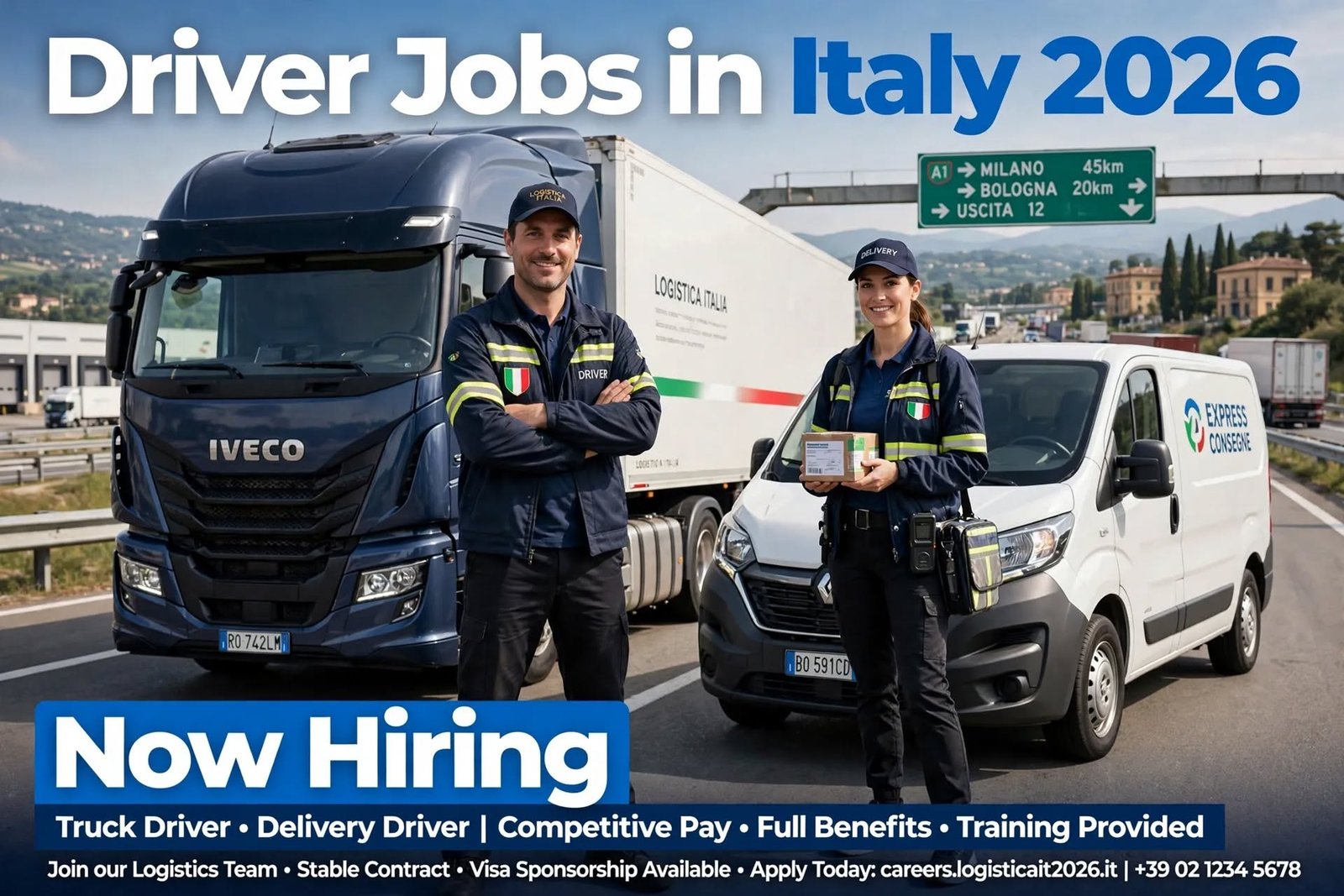
Italy is a country that moves. Fresh produce travels from Sicily to Milan, fashion leaves Tuscany for Paris, parcels reach apartments in Rome within a day and millions of commuters ride buses every morning. Behind all of this movement are people behind the wheel.
That is why driver jobs in Italy are among the most in-demand roles in the country. Transport companies have struggled for years to fill vacancies, and the shortage of professional drivers is a recurring topic across Europe. For skilled and licensed drivers, this creates real opportunities.
But driving work in Italy also comes with strict licensing rules, mandatory qualifications and a visa process that confuses many applicants. This guide walks you through each step: the types of jobs, salaries, licence requirements, visa routes, where to apply and how to avoid costly mistakes.
Read Also: Packing Jobs in Italy
Types of Driver Jobs in Italy
“Driver” covers many different roles. Knowing the categories helps you target the right employers.
Truck Drivers (Autisti di Camion)
Truck drivers move goods across Italy and often into neighbouring countries. Roles include:
- Long-haul and international drivers: routes across Italy and Europe, sometimes with nights away from home
- Regional and national drivers: deliveries within Italy, often returning home on a regular schedule
- Local distribution drivers: short routes serving shops, warehouses and factories
- Specialised drivers: tankers, refrigerated vehicles, car transporters or dangerous goods carriers
Delivery and Courier Drivers (Corrieri / Fattorini)
E-commerce has created a huge demand for van drivers who deliver parcels to homes and businesses. Italy’s large courier networks and subcontracted delivery companies hire throughout the year, with peaks around the holiday season.
Bus and Coach Drivers (Autisti di Autobus)
City transport companies and intercity bus operators need drivers for urban routes, school transport, tourist coaches and regional services. These roles often come with stable schedules and strong employment protection.
Taxi, NCC and Private Hire Drivers
Taxi and NCC (noleggio con conducente, chauffeur hire) work usually involves local licensing and often self-employment, so it is less common as a first role for newcomers.
Other Driving Roles
- Forklift and warehouse vehicle operators
- Waste collection drivers
- Construction and heavy equipment transport
- Agricultural and tractor drivers
Why Italy Needs Drivers
Italy sits at the heart of European trade. Its manufacturing, food and fashion industries export heavily, while its mountainous geography means most freight still moves by road. Several trends keep demand high:
- An ageing driver workforce, with many experienced drivers approaching retirement
- Fewer young Italians entering the profession, often because of long hours and time away from home
- Rapid growth in e-commerce and parcel delivery
- Expanding public transport and tourism needs
- High costs of getting a professional licence, which keeps the pool of qualified drivers small
Because of this, employers are increasingly open to hiring foreign drivers who can meet the licensing requirements.
Driver Salary in Italy
Italy has no national minimum wage. Driver pay is set by collective agreements (CCNL), mainly the one covering logistics, freight transport and shipping, and separate ones for public transport and bus services. Your pay depends on your vehicle category, experience, route type and employer.
As a general guide, many full-time drivers earn approximately:
- Delivery van drivers: around €1,200 to €1,600 net per month
- Regional and national truck drivers: around €1,500 to €2,100 net per month
- International long-haul drivers: often higher, sometimes €1,800 to €2,500 net or more, thanks to travel allowances (trasferte)
- Bus drivers: typically around €1,300 to €1,800 net, with stable schedules and benefits
These figures are only estimates and vary across the country. Your contract and payslip are what count.
Extra Pay and Benefits
- Travel allowances (indennità di trasferta) for nights away or international routes
- Overtime and night or weekend supplements
- Thirteenth and fourteenth month pay
- Paid leave, sick pay and public holidays
- TFR (severance pay) built up over your employment
- Social security contributions toward pension and healthcare
- Meal vouchers or fuel and equipment support, depending on the employer
Ask your employer precisely how allowances are calculated, because they often make up a large part of a long-haul driver’s earnings.
Licence and Qualification Requirements
This is the most important section. In Italy, professional driving is highly regulated, and holding a licence from your home country is usually not enough on its own.
1. The Right Licence Category
- Category B: cars and vans up to 3.5 tonnes (many delivery roles)
- Category C: rigid trucks over 3.5 tonnes
- Category CE: trucks with trailers or articulated lorries
- Category D and DE: buses and coaches
2. The CQC (Carta di Qualificazione del Conducente)
The CQC is the Driver Qualification Card required for professional drivers of heavy vehicles and buses, in line with EU rules. You need one for goods transport (CQC merci) or passenger transport (CQC persone). It must be renewed periodically through training and, depending on circumstances, tests.
3. The Digital Tachograph Card
Truck and bus drivers must record driving and rest times using a digital tachograph, which requires a personal driver card.
4. Medical Certificate
Professional drivers must pass a medical examination, including vision and general fitness.
5. Optional Certifications
- ADR for transporting dangerous goods, which can significantly raise your pay
- Forklift certification for loading and unloading
- Specialist endorsements for tankers or refrigerated transport
Foreign Licences
- EU/EEA licences are generally valid in Italy, though you still need the CQC for professional work.
- Non-EU licences usually cannot be used indefinitely. Depending on your country and Italy’s agreements with it, you may need to convert your licence or take Italian tests. Rules and deadlines apply, so check with the Italian authorities (the Motorizzazione Civile) soon after arriving.
- Professional qualifications from outside the EU are often not automatically recognised, so many non-EU drivers must obtain the Italian CQC.
Some employers pay for or help organise training and licence conversion. Ask about this before accepting a role, and get any agreement in writing.
Working Hours and Rest Rules
Professional drivers in Italy follow EU regulations designed to prevent fatigue. Key points include:
- Daily driving is generally limited to 9 hours, extendable to 10 hours twice a week
- A 45-minute break is required after 4.5 hours of driving
- Daily and weekly rest periods are mandatory
- A weekly driving limit applies, along with a limit over two consecutive weeks
- Everything is recorded by the tachograph and can be inspected by authorities
These rules protect you. A responsible employer will plan routes within them, and you should be wary of any company that pressures you to break them.
Visa Requirements for Non-EU Drivers
EU, EEA and Swiss Citizens
You can work in Italy without a visa. You still need the correct licence, CQC and tachograph card for heavy vehicles.
Non-EU Citizens
Most non-EU workers must be hired through the Decreto Flussi, Italy’s annual quota system for foreign workers. The general process is:
- An Italian employer applies for a work authorisation (nulla osta) through the Ministry of the Interior’s online system during the official application windows.
- If it is approved, the document is sent to the Italian embassy or consulate in your country.
- You apply for a work visa and travel to Italy.
- After arrival, you sign the residence contract and apply for a permesso di soggiorno.
- You complete any outstanding licence conversion and qualification steps in Italy.
The quotas are planned in three-year cycles and set the sectors in which foreign workers may be hired, so whether driving roles can be sponsored depends on the decree currently in force. Check the latest rules with the official government portals or a qualified immigration adviser before you plan.
The Golden Rule
The employer applies for you, and you should never pay for a quota slot or a guaranteed visa. Be extremely careful with agents who claim they can “arrange” a driver visa for a fee.
Skills and Qualities Employers Look For
- A clean driving record and responsible attitude
- Experience with the relevant vehicle type (trucks, vans or buses)
- Route planning and navigation skills, including GPS and digital delivery apps
- Basic Italian or English, especially for safety instructions, paperwork and customer contact
- Time management and reliability
- Physical stamina for long shifts and loading tasks
- Customer service skills, particularly for delivery and bus roles
- Basic vehicle checks and fault reporting
Documents to Prepare
- Valid passport
- Driving licence and proof of experience
- Updated CV with driving history
- References from previous employers
- Medical certificate where required
- After arrival: codice fiscale (Italian tax code) and residence documents
How to Find Driver Jobs in Italy
- Update your CV. List your licence categories, years of experience, vehicle types and any ADR or similar certificates.
- Search job boards. Use Indeed Italia, InfoJobs and LinkedIn with Italian keywords such as autista patente C, autista CE, autista corriere and autista autobus.
- Contact staffing agencies. Randstad, Adecco, Gi Group, Manpower and Umana place many drivers and logistics workers.
- Apply directly to transport companies. Freight carriers, courier firms, supermarket distributors and local bus operators publish vacancies on their websites.
- Look at logistics hubs. Areas around Milan, Bologna, Piacenza, Verona, Padua and Rome have many warehouses and fleets.
- Use EURES if you are an EU citizen.
- Visit the local employment centre (Centro per l’Impiego) if you are already in Italy.
- Prepare for a practical assessment. Some employers test driving skills or ask detailed questions about regulations and safety.
How to Avoid Driver Job Scams
Because the shortage of drivers is well known, scammers exploit it. Look out for:
- Requests for payment for visas, licences, “priority” placement or training that the employer supposedly requires
- Offers with no interview or company verification
- Promises of very high salaries for newcomers
- Recruiters who avoid sharing the company name, VAT number or address
- Pressure to send documents, passport copies or money quickly
- Training or licence-conversion schemes run by unlicensed agents
Verify employers through Italy’s business registry, call the company directly and confirm that the vacancy exists. A genuine employer pays for its own hiring and sponsorship process. If anything feels wrong, check with the Italian embassy in your country.
Life as a Driver in Italy
Driving work is rewarding but demanding. Here is what to expect:
- Irregular hours, including early starts, nights or weekends
- Time away from home for long-haul roles
- Varied scenery and independence, which many drivers enjoy
- Traffic and toll roads, especially around major cities
- Strict compliance with rules, from speed limits to tachograph records
Living costs outside the largest cities are lower, which helps drivers on modest salaries save money. Learning Italian quickly makes daily life, paperwork and customer contact much easier.
Career Growth for Drivers
Driving can be a stable long-term career, and there are clear ways to move up:
- Gain ADR certification to haul dangerous goods at higher pay
- Move into international routes, which often pay better
- Become a fleet or transport coordinator, planning routes and managing drivers
- Train as an instructor or examiner for professional drivers
- Work toward a permanent contract, which supports permit renewals and long-term residence
- Improve your Italian, which opens supervisory and customer-facing roles
Experienced, reliable drivers with the right qualifications are valued, and Italian experience is recognised across Europe.
Conclusion
Driver jobs in Italy offer strong demand, reasonable pay and a clear career path for people who meet the licensing rules and are ready to work hard. The challenge is not finding vacancies. It is meeting the qualification requirements, understanding the visa system and choosing a trustworthy employer.
Start by checking your licence category and CQC requirements. Research your visa route carefully, apply only to verified companies and never pay for promises of a visa or job. With the right preparation and patience, a driving job in Italy can be the start of a secure career in Europe.
Frequently Asked Questions (FAQ)
1. Can I drive a truck in Italy with my foreign licence?
EU licences are generally valid, but you still need the CQC for professional work. Non-EU licences often need to be converted or replaced, and foreign professional qualifications may not be recognised automatically.
2. What is the CQC and do I need it?
The CQC is the Driver Qualification Card required for professional drivers of heavy goods vehicles and buses. If you drive trucks or buses for work, you will need it.
3. How much does a truck driver earn in Italy?
Many full-time truck drivers earn roughly €1,500 to €2,500 net per month, depending on route type, experience and allowances. International long-haul work usually pays more.
4. Can non-EU citizens get a driver job with visa sponsorship?
Possibly, but it depends on the Decreto Flussi in force, the employer’s application and quota availability. No agent can guarantee it, so verify the current rules officially.
5. Do I need to speak Italian to work as a driver?
Basic Italian is strongly recommended for safety instructions, paperwork and communication. Some employers accept English, but Italian greatly improves your chances.
6. Which driver jobs are easiest to start with?
Delivery van driving usually has lower entry barriers than heavy truck or bus roles because it often needs only a category B licence. Truck and bus work require C, CE or D licences plus the CQC.
7. How many hours can a truck driver work in Italy?
Driving time is limited under EU rules, generally 9 hours per day (up to 10 twice a week), with mandatory breaks and rest periods recorded by the tachograph.
8. How can I spot a fake driver job offer?
Be suspicious of requests for money, missing contracts, vague company details or very high pay promises. Verify the employer and never pay for a visa or placement.
Disclaimer: Licensing, visa rules, quotas and wages change regularly. Confirm current details with official Italian government sources or a qualified adviser before making decisions.
One thought on “Driver Jobs in Italy: Complete Guide to Salary, Licences, Visa and How to Apply (2026)”