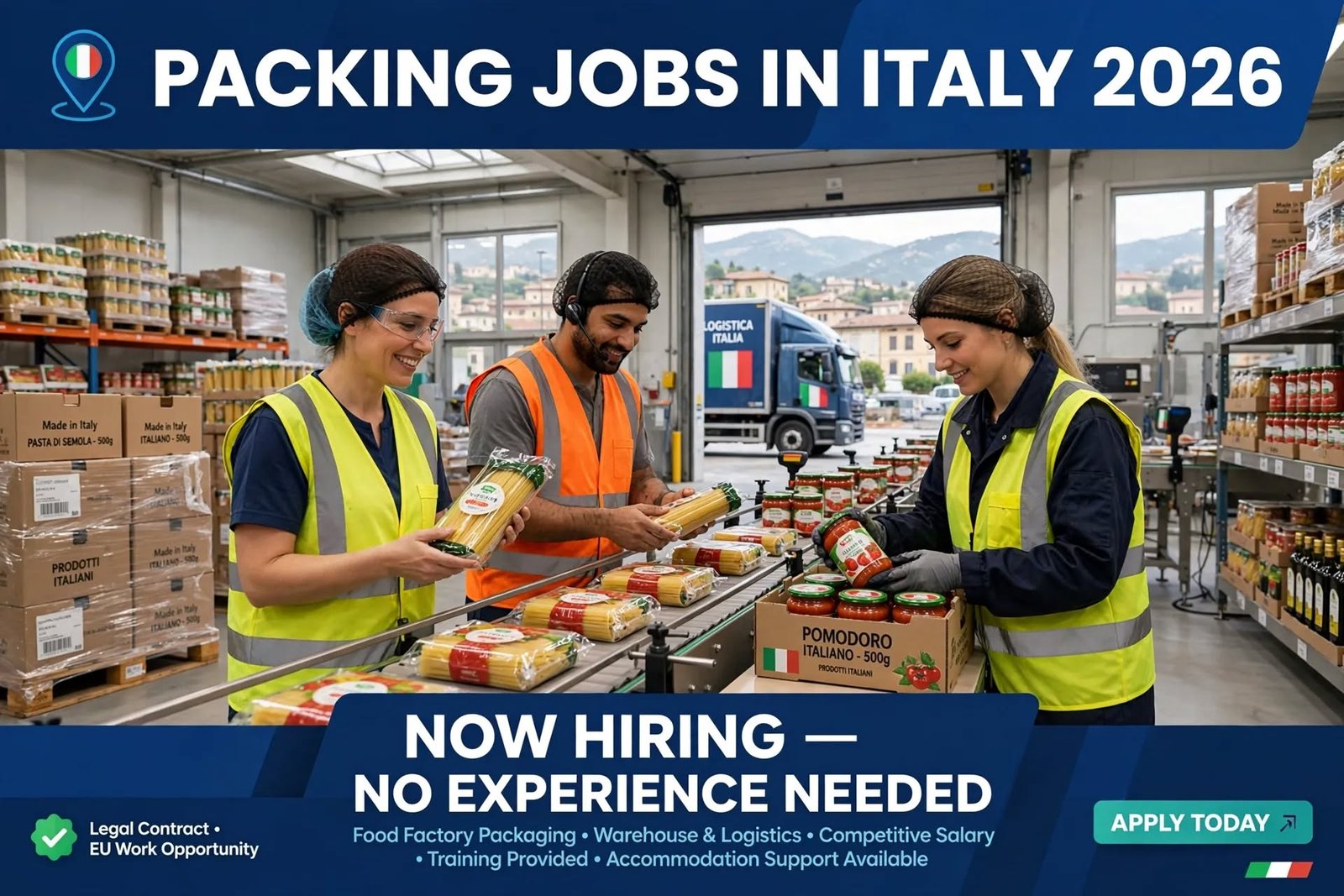
Italy is known for fashion, food, machinery and design. Behind every pair of leather shoes, every wheel of Parmigiano and every parcel that leaves a warehouse near Milan, there is someone who sorts, checks, packs and labels it.
That is why packing jobs in Italy are among the most consistent entry-level opportunities in the country. They need no university degree and no fluent Italian on day one, and they are available in almost every region. For many international job seekers, packing work is the first step toward a stable life in Europe.
This guide covers what these jobs involve, how much they pay, which regions hire most, how the visa process works for non-EU citizens and how to avoid the scams that target hopeful applicants. Read it fully before you spend a single rupee, dollar or euro on an application.
What Are Packing Jobs in Italy?
Packing jobs, also called packaging jobs, involve preparing products for storage, shipping or sale. The work happens in factories, food-processing plants, warehouses, fulfilment centres and agricultural packhouses.
Common Job Titles to Search For
Italian employers often use Italian titles in their listings. Learn these and your searches will return far better results:
Read Also: Dairy Farm Jobs in Italy
- Addetto/a al confezionamento: packaging operator
- Addetto/a all’imballaggio: packing worker
- Operaio/a di produzione: production line worker
- Magazziniere/a: warehouse worker
- Addetto/a alla logistica: logistics assistant
- Addetto/a alle spedizioni: shipping clerk
- Etichettatrice / addetto etichettatura: labelling operator
Typical Daily Tasks
Your duties depend on the industry, but most packers do some combination of the following:
- Placing products into boxes, bags, trays or cartons
- Checking items for defects or damage
- Operating or feeding semi-automatic packaging machines
- Applying labels, barcodes and tracking stickers
- Sealing, wrapping and palletising finished goods
- Scanning and recording stock with a handheld device
- Keeping the work area clean and following hygiene rules
The work is physical but structured. Most days involve standing for long periods, repeating movements and lifting moderate weights, so a reasonable level of fitness helps.
Why Italy Needs Packing Workers
Italy is Europe’s second-largest manufacturing economy and a major exporter. That creates steady demand across several sectors:
- Food and beverage: pasta, olive oil, cheese, cured meats, wine, confectionery and frozen foods all need hygienic, accurate packaging.
- Fashion and luxury: clothing, footwear and accessories are packed with great attention to presentation.
- E-commerce and logistics: online shopping has pushed up demand for fulfilment-centre workers, especially near big transport hubs.
- Agriculture: fruit and vegetable packhouses hire heavily at harvest time.
- Pharmaceuticals and cosmetics: these need careful, clean-environment packing.
- Furniture and ceramics: fragile or bulky goods need skilled wrapping and crating.
Italy also has an ageing population and a shrinking local workforce in manual roles. The government has openly acknowledged that it needs foreign labour, which is why quotas for non-EU workers keep growing.
Where Are the Best Packing Jobs in Italy?
The north generally has more industrial and logistics roles, while the south has more seasonal agricultural work.
Northern Italy
- Lombardy (Milan, Bergamo, Brescia): Italy’s industrial heartland, with huge logistics and manufacturing clusters.
- Emilia-Romagna (Bologna, Parma, Modena, Piacenza): food production, packaging machinery and large distribution hubs.
- Veneto (Verona, Padua, Treviso): manufacturing, fashion and export-focused warehouses.
- Piedmont (Turin, Cuneo): food, beverage and automotive supply chains.
- Trentino-South Tyrol: apple and fruit packing in season.
Central and Southern Italy
- Lazio (Rome area): logistics and distribution around the capital.
- Campania (Naples, Salerno): food canning, tomato processing and distribution.
- Puglia and Sicily: olive oil, citrus, grapes and vegetables, with a strong harvest-season component.
A practical tip: a smaller town near an industrial district often offers cheaper rent and similar wages to a big city. That leaves you with more money at the end of the month.
Packing Job Salary in Italy
Italy has no single national minimum wage. Pay is set through collective labour agreements (known as CCNL) negotiated between unions and employers’ associations for each sector. A packer in food processing, one in logistics and one in retail distribution may each fall under a different agreement.
As a rough guide, many full-time packing and warehouse workers earn somewhere in the range of €1,100 to €1,500 net per month, depending on the sector, region, shift pattern and experience. Night shifts, weekend work and overtime usually pay a premium. Treat these as ballpark figures, because your contract is what counts.
Benefits You Should Expect
Italian employment law gives workers more protection than many newcomers expect:
- Thirteenth and fourteenth month pay (tredicesima and quattordicesima): many contracts include extra monthly salaries paid in December and summer.
- Paid holiday and public holidays: a minimum annual leave entitlement applies.
- TFR (trattamento di fine rapporto): a severance amount that builds up and is paid when the job ends.
- Social contributions: your employer pays into pension, health and unemployment systems.
- Access to public healthcare through the national system once you are registered.
- Safety training: employers must provide it under Italian workplace-safety law.
Always ask which CCNL applies to your contract and check your first payslip (busta paga) carefully.
Working Hours and Contract Types
A standard full-time week is typically about 40 hours, though specific agreements vary. Packing factories often run in shifts, such as morning, afternoon and sometimes night.
Common contract types include:
- Tempo determinato (fixed-term): a contract with an end date, often 3 to 12 months. This is very common for first jobs.
- Somministrazione (agency work): you are employed by a staffing agency and placed with a client company. It is a frequent entry route into factories and warehouses.
- Tempo indeterminato (permanent): an open-ended contract, usually offered after you have proved yourself.
- Stagionale (seasonal): short-term work tied to harvests or tourism peaks.
A written contract is your protection. Never start work without one.
Visa Rules for Non-EU Citizens
This is the section where most people either succeed or lose money, so read it carefully.
EU/EEA Citizens
If you hold an EU, EEA or Swiss passport, you can live and work in Italy without a visa. You can apply directly, though you must register your residence after a few months.
Non-EU Citizens
For most nationalities, including India, Pakistan, Bangladesh, Nepal and many African countries, you need employer sponsorship under the Decreto Flussi, the annual quota decree. Here is how it works:
- An Italian employer decides to hire you and applies for a work authorisation (nulla osta) through the Ministry of the Interior’s online portal.
- Applications are submitted on fixed “click days” in line with the quota system.
- If approved, the nulla osta is sent to the Italian embassy or consulate in your country.
- You apply for the work visa there and travel to Italy.
- Within days of arrival you sign your contract at the local immigration office and apply for your permesso di soggiorno (residence permit).
The decree sets a ceiling on how many non-EU citizens may enter for seasonal, non-seasonal and self-employed work. For 2026–2028 the quotas are 164,850 entries for 2026, 165,850 for 2027 and 166,850 for 2028, with seasonal work in agriculture and tourism accounting for a growing share. Applications for 2026 were submitted through the ministry’s portal on set click days in the early part of the year. For the next round, check the official portal and your employer’s adviser for current dates, because timing and rules can change. esterieiglaw
The Most Important Point
The employer applies for you. You cannot buy a “quota slot,” and no legitimate agent can guarantee one. Processing from application to arrival can take several months.
Skills and Requirements
Packing is accessible, but employers still look for certain qualities:
- Reliability and punctuality, which are valued above almost everything else
- Physical stamina for standing and repetitive tasks
- Attention to detail, especially in food and pharmaceutical packing
- Basic Italian or English, enough to follow safety instructions
- Teamwork and willingness to work in shifts
- Basic machine or forklift experience (a patentino for forklifts can raise your pay)
For food-related roles, employers may require hygiene training (HACCP), which is often provided on the job.
Documents to Keep Ready
- Valid passport
- Updated CV in European format
- Copies of any certificates or references
- Police clearance, depending on visa requirements
- Passport-size photographs
- After arrival: your codice fiscale (Italian tax code), which you need for contracts, banking and healthcare
How to Find Packing Jobs in Italy: Step by Step
- Build a simple CV. Keep it to one page and highlight any warehouse, factory, retail or farm experience.
- Search the right platforms. Indeed Italia, InfoJobs, Subito Lavoro and LinkedIn are good starting points. Use Italian keywords like addetto imballaggio and operaio confezionamento.
- Contact staffing agencies. Randstad, Adecco, Manpower, Gi Group and Umana place many workers in packing and logistics roles.
- Check company career pages. Large food producers, logistics firms and e-commerce warehouses post openings directly.
- Use EURES (EU citizens). This is the official EU job mobility portal.
- Apply locally if you are already in Italy. The Centri per l’Impiego (public employment centres) can help residents find openings.
- Prepare for a short interview. Expect simple questions about your availability, shift flexibility and experience.
- Get everything in writing before you commit to travel.
How to Avoid Packing Job Scams in Italy
Because packing roles are popular, fraudsters target applicants, often through social media and messaging apps. Watch for these red flags:
- Anyone asking you to pay for a “guaranteed” visa, quota slot or job placement
- Offers that arrive without any interview
- Unrealistic salaries for entry-level work
- Recruiters who refuse to share the company’s name, VAT number (partita IVA) or address
- Pressure to transfer money quickly or to share bank details
- Emails from free addresses instead of company domains
Before trusting any offer, search the company on Italy’s business registry, call the listed number and confirm the vacancy exists. In legitimate hiring, the employer covers the costs of its own sponsorship application. If in doubt, ask the Italian embassy in your country.
Cost of Living and Daily Life
Wages for packers are modest, but living costs outside major cities are manageable:
- Rent: a shared room in a smaller town can cost far less than in Milan or Rome.
- Food: supermarkets and local markets are affordable, and cooking at home saves a lot.
- Transport: monthly passes are inexpensive, and many factories sit in industrial areas, so check bus or shuttle options before choosing housing.
- Language: even basic Italian opens doors, builds friendships and improves your chances of a permanent contract.
Some employers, especially in seasonal agriculture, offer or help arrange accommodation. Make sure any housing arrangement is stated clearly in writing.
Growing Your Career After Packing
A packing job does not have to be a dead end. Many workers use it as a springboard:
- Learn Italian. Free or low-cost courses are often offered by local authorities and community groups.
- Earn certificates. Forklift operation, warehouse management software and safety qualifications raise your value.
- Move into higher-skilled roles. Line supervisor, quality controller, machine operator and logistics coordinator are common next steps.
- Aim for a permanent contract. Stability makes it easier to renew your permit, rent a home and eventually bring family.
- Keep records. Save payslips and contracts, since they matter for permit renewals and long-term residence.
Conclusion
Packing jobs in Italy offer a realistic, legal and often well-protected route into the European workforce. They need no advanced degree, they exist across the country and they can lead to better roles with the right skills and some Italian. For non-EU citizens the key is to understand the Decreto Flussi system, use only verified employers and agencies and never pay anyone for a promise of a visa.
Research carefully, prepare your documents, stay alert to scams and be patient with the process. With the right approach, a packing job can be the first step in a long-term career in Italy.
Frequently Asked Questions (FAQ)
1. Do I need to speak Italian to get a packing job in Italy?
Not always. Many entry-level employers accept basic English or very limited Italian, but you must understand safety instructions. Learning even simple Italian greatly improves your chances and your daily life.
2. Can I get a packing job in Italy with visa sponsorship?
Yes, but sponsorship comes through an Italian employer applying within the Decreto Flussi quota system. It is not something an agent can sell you, and approval is not guaranteed.
3. How much does a packer earn in Italy?
Many full-time packers earn roughly €1,100 to €1,500 net per month, depending on sector, region and shifts. Pay is set by the applicable collective agreement, so check your contract.
4. Which Italian regions hire the most packers?
Lombardy, Emilia-Romagna, Veneto and Piedmont have the most year-round industrial and logistics roles. Southern regions and Trentino-South Tyrol hire heavily for seasonal fruit and vegetable packing.
5. Is it legal for an employer to charge me for a job?
No legitimate employer should charge you for hiring you or for filing their own sponsorship application. Treat any request for payment as a major red flag.
6. Can a packing job lead to permanent residence in Italy?
It can. Holding a stable contract, renewing your permit on time and keeping your records in order are the foundations of long-term residence, though conditions apply and rules change, so confirm current requirements with the Questura or an immigration adviser.
7. How long does the work visa process take?
From the employer’s application to your arrival, expect several months. Timing depends on the quota round, your embassy and document checks.
Disclaimer: Visa rules, quotas and wages change. Verify details with official Italian government sources or a qualified adviser before making decisions.
2 thoughts on “Packing Jobs in Italy: Complete Guide to Salary, Visa and How to Apply (2026)”