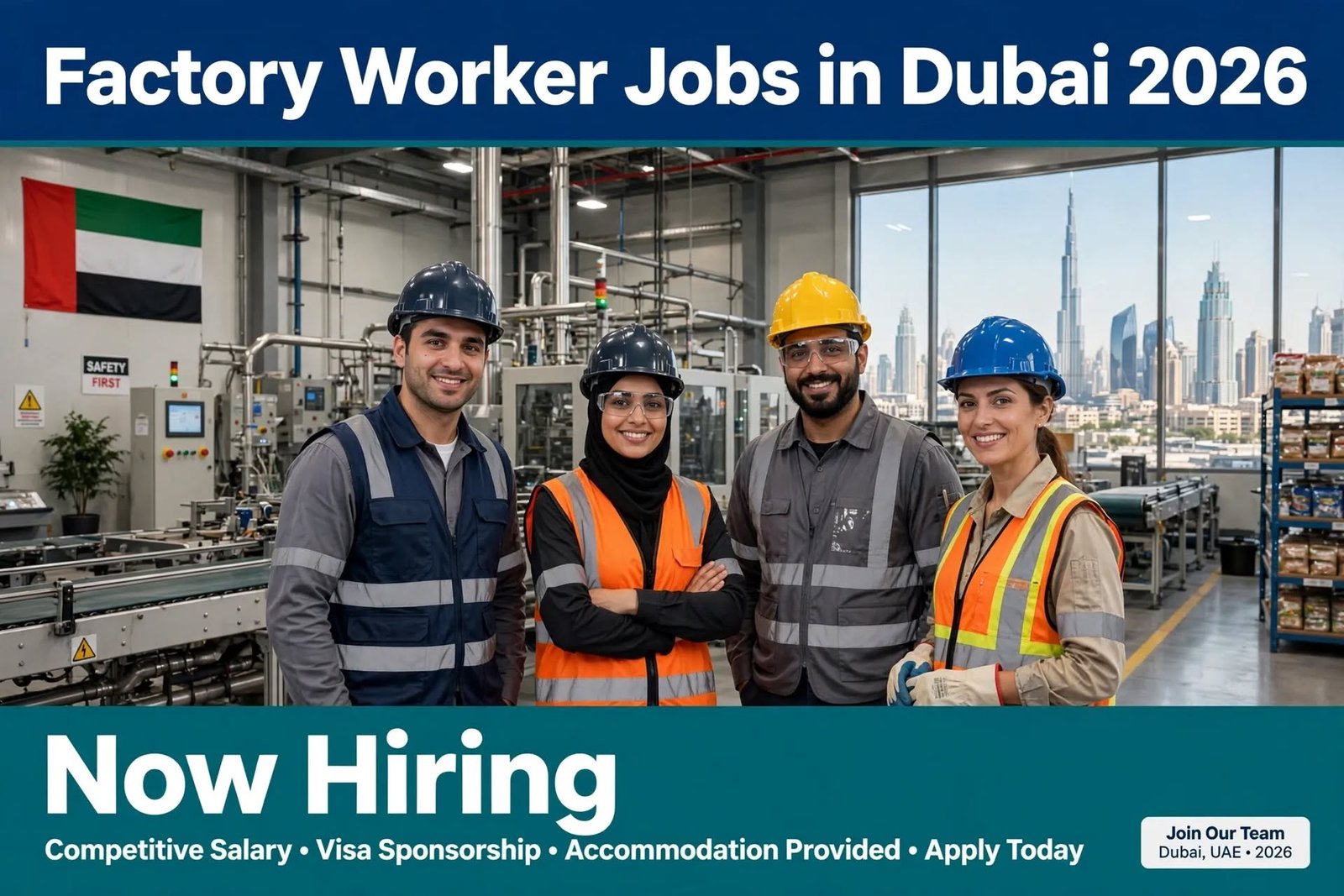
Dubai is known for its skyline, but behind the glass towers is a huge industrial machine. Food plants, plastics units, steel fabrication shops, packaging facilities, and furniture workshops all run around the clock. Every one of them needs people on the floor. That is why factory worker jobs in Dubai remain some of the most sought-after blue-collar opportunities for job seekers from South Asia, Africa, and Southeast Asia.
The appeal is easy to see. Salaries are paid in dirhams, the UAE has no personal income tax, and many employers offer accommodation and transport. For many families, one stable factory job can change what is possible back home.
But there is a catch. Where there is demand, there are also scams, unrealistic promises, and confusing paperwork. This guide explains how factory jobs in Dubai really work: the types of roles, what you can expect to earn, which areas hire the most, what documents you need, and how to protect yourself while applying.
Why Factory Jobs in Dubai Attract So Many Workers
A Growing Industrial Base
Dubai has deliberately diversified beyond oil and tourism. Manufacturing, logistics, and re-export trade are major parts of the economy. Large zones such as Jebel Ali Free Zone (JAFZA), Dubai Industrial City, and Dubai Investments Park (DIP) host hundreds of factories, and many of them export across the Middle East, Africa, and Asia.
Read Also: Plumber Jobs in Italy
Tax-Free Income
Workers in the UAE do not pay personal income tax on their wages. What you earn on payday is largely what you keep, which makes saving and sending money home far easier than in many other countries.
Employer-Provided Benefits
Many factory employers provide some or all of the following, depending on the contract:
- Shared staff accommodation
- Transport between the camp and the factory
- Medical insurance (mandatory for employees in Dubai)
- Annual leave and an air ticket home at intervals set in the contract
- End-of-service gratuity after completing the qualifying period
A Path to Skill Growth
A helper today can become a machine operator tomorrow. Many factories promote reliable workers into supervisory or technical roles over time.
Types of Factory Worker Jobs in Dubai
“Factory worker” is a broad label. Here are the most common roles.
1. General Production Worker / Factory Helper
This is the main entry-level role. You may feed materials into machines, assemble parts, clean work areas, and move items along the production line. No advanced qualification is usually needed, although basic fitness and willingness to learn are important.
2. Machine Operator
Operators run equipment such as cutting, molding, bottling, or printing machines. Employers often prefer people with prior machine experience, but some train promising helpers on the job.
3. Packaging and Labelling Staff
Food, cosmetics, household goods, and electronics all need to be sorted, packed, and labelled before leaving the factory. The work is repetitive but steady, and it is a common starting point for new arrivals.
4. Quality Control (QC) Assistant
QC assistants inspect products for defects, check weights and measurements, and record results. Attention to detail matters more than physical strength here.
5. Welder, Fabricator and Metalworker
Steel and aluminium fabrication shops in areas like Al Quoz and Jebel Ali hire skilled welders, grinders, and fitters. Trade certificates or proven experience can earn noticeably higher pay.
6. Forklift Operator and Store Helper
Factories need people to move raw materials and finished goods. A valid forklift license can set you apart from other applicants.
7. Food Processing Worker
Bakeries, dairy plants, beverage bottlers, and meat or snack processors hire many workers. Hygiene training and food-safety rules apply.
8. Furniture, Carpentry and Woodwork Staff
Dubai’s construction and interior-design sectors keep furniture and joinery workshops busy. Carpenters, painters, and finishers are regularly needed.
9. Textile and Garment Workers
Smaller garment units and uniform producers hire tailors, cutters, pressers, and finishing staff.
How Much Do Factory Workers Earn in Dubai?
Pay depends on your role, experience, employer, and contract terms. The figures below are rough ranges based on commonly advertised offers. Treat them as a guide, not a guarantee, and always check the written contract.
| Role | Approximate Monthly Basic Pay (AED) |
|---|---|
| Factory helper / general worker | 800 – 1,500 |
| Packaging / labelling staff | 900 – 1,600 |
| Machine operator | 1,500 – 2,800 |
| Forklift operator | 1,500 – 2,500 |
| Welder / fabricator | 1,800 – 3,500 |
| QC assistant | 1,500 – 3,000 |
| Supervisor / line leader | 2,800 – 5,000 |
What Affects Your Salary?
- Skills and certificates: Trade tests and licences raise your value.
- Overtime: Many factories pay extra for additional hours, and this can add a meaningful amount each month.
- Accommodation and food: If the employer provides housing and meals, the basic salary may be lower. If not, your costs rise.
- Employer size: Large, established companies often have more structured pay and benefits.
Basic Salary vs. Total Package
Always ask how the offer is split between basic salary, housing allowance, transport allowance, and overtime. Gratuity is usually calculated on the basic salary, so a very low basic figure with large allowances can reduce your final payout.
Best Areas in Dubai for Factory Jobs
Jebel Ali Free Zone (JAFZA)
One of the largest free zones in the region, close to Jebel Ali Port. It houses manufacturers, logistics firms, and assembly plants.
Dubai Industrial City
A purpose-built industrial community with factories in food, construction materials, machinery, and more.
Dubai Investments Park (DIP)
A mixed industrial and residential area, popular for plastics, packaging, and light manufacturing, with workers’ housing nearby.
Al Quoz Industrial Area
A long-established district full of workshops, fabrication units, furniture makers, and small factories.
Ras Al Khor and Al Qusais Industrial Areas
These areas have a mix of manufacturing, warehousing, and trading companies that often hire production and packing staff.
Tip: Many factories advertised as “Dubai” jobs may sit in nearby emirates like Sharjah or Ajman. Confirm the exact work location and the visa emirate before accepting an offer.
Eligibility and Requirements
Requirements vary, but most employers look for the following:
- Age: Usually 21 to 45, though some roles accept slightly different ranges.
- Education: Basic literacy is often enough for helper roles. Technical roles may need a diploma or trade certificate.
- Experience: Not always required for entry-level work, but it improves your chances and your pay.
- Medical fitness: You must pass the UAE medical screening for a residence visa.
- Basic English or Hindi/Urdu: Helpful for following safety instructions and talking with supervisors.
- Clean record: A valid passport and, in some cases, a police clearance certificate.
Documents You Will Need
Keep these ready before you apply:
- Valid passport (ideally with at least six months of validity remaining)
- Passport-size photographs with a white background
- Updated CV (one page is enough for most factory roles)
- Educational or trade certificates, if applicable
- Experience letters from previous employers
- Police clearance certificate, if requested
- Driving or forklift licence, if relevant to the role
UAE Work Visa Process for Factory Workers
Understanding the process protects you from fraud. In general, the legal route works like this:
- Employer offers the job and applies for a work permit through official UAE channels.
- You receive an offer letter and contract. Read every clause before signing.
- Entry permit is issued for you to travel to the UAE.
- You arrive and complete the medical test and Emirates ID biometrics.
- Residence visa is stamped, and your labour card details are finalized.
The Golden Rule
In the UAE, the employer pays for the work permit and recruitment costs. A worker should not be asked to pay for the visa, work permit, or job placement. Regulations require that recruitment costs be borne by the employer, not the employee. If anyone asks for a large “visa fee” in exchange for a job, treat it as a serious warning sign.
How to Find Factory Jobs in Dubai
Official and Trusted Sources
- Company career pages of manufacturers in JAFZA, DIP, and Dubai Industrial City
- Licensed recruitment agencies in your home country, registered with your government’s overseas employment authority
- Reputable job portals that verify employers
- The UAE Ministry of Human Resources and Emiratisation (MoHRE) website for rules and verification of offers
Practical Search Tips
- Search using specific phrases like “production operator Dubai,” “factory helper Jebel Ali,” or “packing staff DIP.”
- Set alerts on trusted job portals.
- Follow factory and manufacturer pages for hiring announcements.
- Ask friends or relatives already working in the UAE, but still verify any lead independently.
How to Apply: A Step-by-Step Approach
- Prepare a simple, honest CV. List your work history, skills, languages, and contact details.
- Apply only to verified employers or licensed agencies.
- Prepare for a trade test or interview. Some factories test practical skills; others hold video interviews.
- Ask for the offer letter in writing before paying for or arranging anything.
- Check the contract details: job title, salary, working hours, overtime rate, accommodation, leave, and contract length.
- Verify the offer through official channels if possible.
- Keep copies of all documents and communication.
Working Conditions and Daily Life
Working Hours
Standard working hours under UAE labour rules are generally capped at eight hours a day, with overtime paid at a higher rate. Factories running shifts may use rotating schedules.
Summer Heat Protection
The UAE enforces a midday work break for outdoor workers during the hottest months. Indoor factory work is air-cooled or ventilated in many facilities, but conditions vary by employer.
Accommodation
Company housing is typically shared, with several workers per room. Look for clear information about room size, location, and facilities.
Safety
Employers are expected to provide protective equipment, training, and safe machinery. Do not hesitate to ask about safety rules before accepting a role.
Cost of Living
Living in company accommodation keeps costs low. Basic expenses such as food, mobile data, and remittance fees add up, so budgeting early helps you save more.
Common Scams and How to Avoid Them
Fake job offers target hopeful workers every year. Watch for these red flags:
- Requests for upfront payment for visas, “processing,” or guaranteed placement
- Offers that seem too good to be true, such as very high pay for no experience
- Visit visas disguised as work visas: a tourist or visit visa does not give you the right to work
- No written contract or vague job descriptions
- Pressure to decide quickly or to send money by informal channels
- Unverifiable agents who only communicate through messaging apps
Protect Yourself
- Verify the agency’s licence with your country’s official authority.
- Confirm the job offer with the company directly through its official website or phone number.
- Never hand over your original passport to an unlicensed middleman.
- Keep records of every payment and message.
Your Rights as a Factory Worker in the UAE
UAE labour law gives workers important protections. In general, you have the right to:
- A written contract that matches the offer you accepted
- Timely payment of wages, usually through the Wage Protection System
- Paid leave and rest days according to the law
- Medical coverage and safe working conditions
- End-of-service gratuity after meeting the qualifying period
- Keeping your own passport. Employers are not permitted to withhold it.
If a dispute arises, you can approach MoHRE through its official complaint channels. Your embassy or consulate can also guide you.
Tips to Get Hired Faster and Earn More
- Add a practical skill. A forklift licence, basic welding certificate, or machine-operation course helps.
- Improve basic English. Even simple spoken English makes you easier to train and promote.
- Be reliable. Punctuality and a good attitude matter a lot to factory supervisors.
- Learn safety standards. Safety awareness makes you a more valuable hire.
- Apply to several employers. Don’t wait on one offer.
- Stay professional online. Use a clear photo, a polite message, and a correct phone number on your applications.
Career Growth: Where a Factory Job Can Lead
Factory work in Dubai doesn’t have to stay entry-level. A typical growth path looks like this:
- Helper / production worker
- Machine operator
- Senior operator or technician
- Line leader or supervisor
- Production or quality coordinator
Each step usually comes with higher pay and more responsibility. Workers who gain certifications, learn multiple machines, or move into quality and safety roles often progress faster.
Frequently Asked Questions (FAQ)
1. Is it easy to get factory worker jobs in Dubai?
Entry-level factory jobs are widely available because the industrial sector keeps expanding. Competition is real, though, so a clear CV, relevant skills, and applying through verified channels will help.
2. Do I need experience to work in a factory in Dubai?
Not always. Helper and packing roles often accept beginners. Machine operator, welder, and QC positions generally prefer or require experience.
3. What is the average salary for a factory worker in Dubai?
Helpers commonly start in the range of roughly AED 800 to 1,500 per month, while skilled roles can earn more. Overtime, allowances, and accommodation affect the final package.
4. Does the employer provide accommodation?
Many do, but not all. Confirm it in writing, along with transport and food arrangements.
5. Should I pay a fee to get a factory job in Dubai?
No. UAE rules place recruitment and work-permit costs on the employer. Demands for large payments are a red flag.
6. Can I work in a Dubai factory on a visit or tourist visa?
No. Working on a visit visa is not legal. You need a proper work permit and residence visa arranged through your employer.
7. How long does the visa process take?
It varies, but it often takes a few weeks from the offer to arrival, depending on documents, approvals, and medical clearance.
8. Are factory jobs in Dubai suitable for women?
Yes, some sectors such as packaging, garments, food processing, and quality control hire women. Check the employer’s accommodation and safety arrangements.
9. What happens if my employer doesn’t pay on time?
Salaries should be paid through the Wage Protection System. If payment is delayed, you can file a complaint with MoHRE.
10. Can I change jobs after arriving?
UAE rules allow job changes under certain conditions, such as completing your contract or following proper notice procedures. Review your contract and current regulations before making a move.
Conclusion
Factory worker jobs in Dubai offer something many workers are looking for: steady income, tax-free earnings, and a chance to build skills in a fast-growing industrial economy. Whether you start as a helper or arrive with trade experience, there is room to grow, as long as you take the right steps.
Remember the essentials. Apply through verified employers and licensed agencies, insist on a written contract, never pay for a work permit, and understand your rights under UAE labour law. Prepare your documents, build one useful skill, and stay patient through the process.
With the right information and careful choices, a factory job in Dubai can be the start of a safer, more secure future for you and your family.
Disclaimer: Salary ranges, rules, and visa procedures change over time. Always verify current details with MoHRE or the official UAE government portal before making decisions.
2 thoughts on “Factory Worker Jobs in Dubai: Salary, Visa Rules and How to Get Hired”