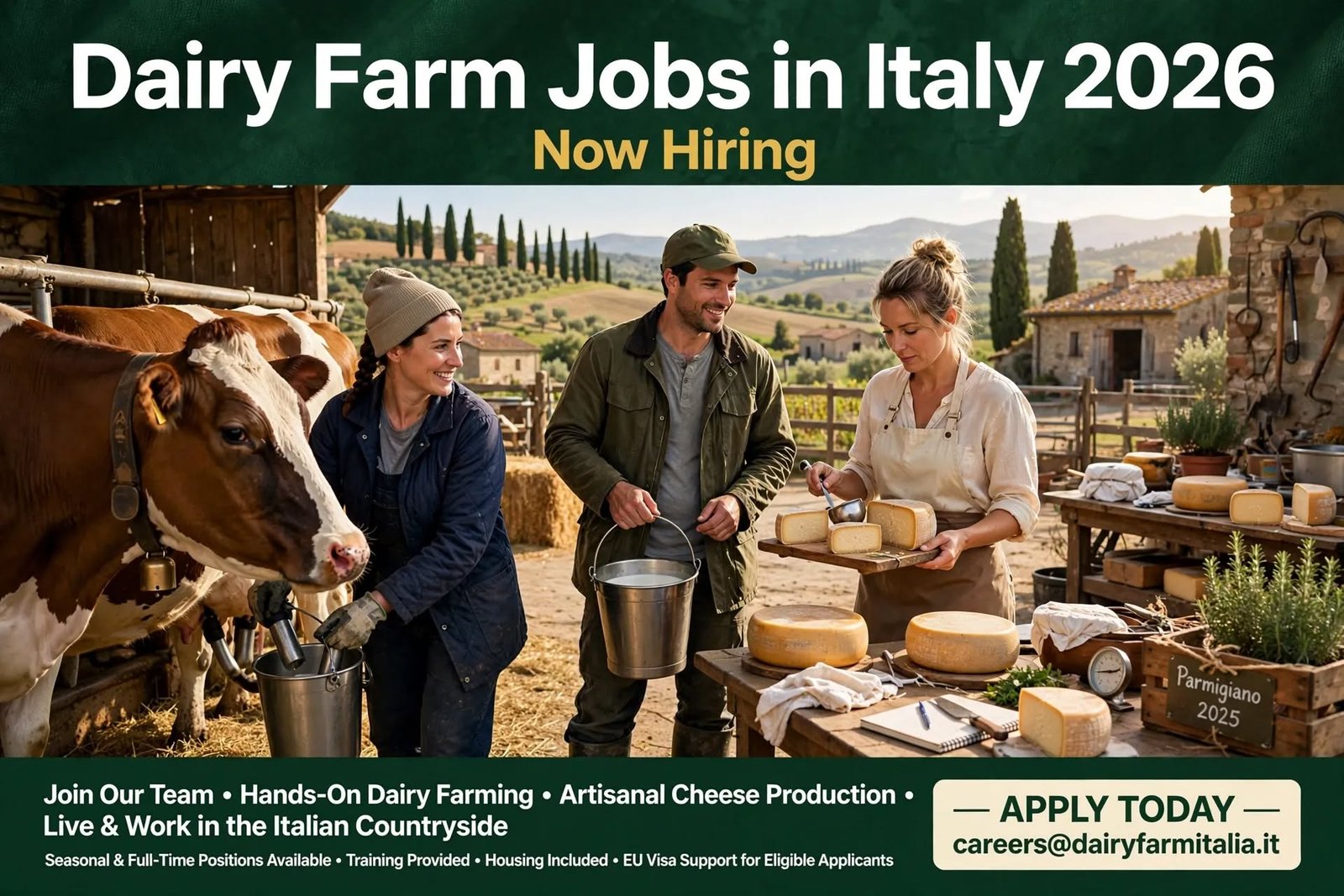
Every wheel of Parmigiano Reggiano, every ball of fresh mozzarella and every litre of Italian milk starts the same way: with someone getting up before sunrise to look after the cows.
Italy has one of Europe’s most respected dairy industries, and it depends heavily on skilled and dedicated farm workers. For job seekers from abroad, dairy farm jobs in Italy can offer steady, year-round work, practical training and sometimes even free accommodation on the farm.
This guide explains what the work involves, what you can earn, where the best opportunities are, how the visa system works for non-EU citizens and how to spot fake offers before they cost you money.
What Do Dairy Farm Jobs in Italy Involve?
A dairy farm is a working business that never fully stops. Cows need milking, feeding and care every single day, including weekends and holidays. That is why farms are always looking for reliable people.
Read Also: Packing Jobs in Italy
Common Job Titles to Know
Italian employers usually post vacancies using Italian terms. Search with these and you will find far more results:
- Mungitore/Mungitrice: milker
- Addetto/a alla stalla: barn or stable worker
- Bovaro: cattle handler or herdsman
- Operaio agricolo: general farm worker
- Trattorista: tractor driver
- Addetto/a alla mungitura robotizzata: robotic milking system assistant
- Casaro / addetto al caseificio: cheesemaker or dairy plant worker
- Allevatore: livestock farmer or breeder
Typical Daily Tasks
Most dairy farm workers handle a mix of the following:
- Milking cows, either by hand-operated equipment, milking parlours or robotic systems
- Cleaning and sanitising milking machines and tanks
- Preparing and distributing feed, silage and fodder
- Cleaning barns and changing bedding
- Observing the herd for signs of illness, injury or heat
- Helping with calving and caring for newborn calves
- Recording milk yields and animal data
- Driving tractors and loaders for farm work
- Basic maintenance of equipment and fences
The work is physical, outdoors in all weather and starts early. Milking commonly takes place twice a day, with the first session often beginning around 4 or 5 am. Many workers say that once the rhythm becomes routine, the job feels purposeful and stable.
Why Italy Has So Many Dairy Opportunities
Italy produces some of the world’s most famous cheeses under protected designations of origin. These include Parmigiano Reggiano, Grana Padano, Gorgonzola, Pecorino and Mozzarella di Bufala Campana. Each depends on a large network of farms producing high-quality milk.
Several factors create demand for workers:
- A strong cheese export market, which keeps production steady
- An ageing farming population, with many local young people choosing other careers
- Labour shortages in livestock work, which is demanding and requires daily presence
- Large, modern farms, many of which are expanding and investing in technology
Foreign workers already make up a large share of the labour force on many Italian dairy farms, particularly in the north, so newcomers often find established communities and colleagues who speak their language.
Best Regions for Dairy Farm Jobs in Italy
Dairy farming is concentrated in the fertile Po Valley, but you can find work in other areas too.
Northern Italy
- Lombardy (Cremona, Mantua, Lodi, Brescia, Bergamo): the country’s top milk-producing region, with large herds and many job openings.
- Emilia-Romagna (Parma, Reggio Emilia, Modena): home of Parmigiano Reggiano, with many family-run farms and cheese cooperatives.
- Veneto (Verona, Vicenza, Padua): a mix of large farms and mountain dairies, including Asiago cheese production.
- Piedmont (Cuneo, Turin): strong dairy and cheese traditions, with mountain and valley farms.
- Trentino-South Tyrol: Alpine dairying, with summer pasture work in high-altitude areas.
Central and Southern Italy
- Lazio (Latina area): buffalo and cow dairies supplying the mozzarella industry.
- Campania (Caserta, Salerno): the centre of buffalo mozzarella production.
- Puglia and Sardinia: sheep and goat dairy, producing pecorino and other traditional cheeses.
Farms in rural areas often have lower living costs than cities, and in some regions employers provide on-site housing.
Dairy Farm Worker Salary in Italy
Italy has no national minimum wage. Pay for agricultural workers is set through collective agreements (CCNL) for farm workers, plus regional and provincial supplements. Your exact pay depends on your skill level, the region, your hours and the employer.
As a broad estimate, many full-time dairy farm workers earn around €1,200 to €1,700 net per month, with experienced milkers, herd managers and machine operators earning more. Treat these as approximate figures, and rely on your contract and payslip for the real numbers.
Extra Benefits You May Receive
- On-farm housing, sometimes free or at a reduced price, which can save a great deal of money
- Thirteenth and fourteenth month payments in many contracts
- Paid leave and public holidays under Italian labour law
- TFR (severance pay) that accumulates during employment
- Social security contributions toward pension, health insurance and unemployment protection
- Overtime or weekend pay, depending on your agreement
- Meals or milk and dairy products supplied by some farms
Ask clearly whether housing and utilities are included, and make sure any deductions appear in writing.
Working Hours, Shifts and Contracts
Dairy work is continuous, so schedules are structured around the milking times. A typical day might include an early morning milking block, a mid-day break, then an afternoon or evening shift. Total hours should fit within the limits of your contract and Italian law, with rest days and compensation for extra work.
Common contract types:
- Tempo determinato (fixed-term): the usual first contract, often 6 to 12 months.
- Tempo indeterminato (permanent): open-ended, typically offered once you have proved yourself.
- Stagionale (seasonal): used for tasks tied to specific periods, such as alpine summer pasture.
Insist on a written contract before travelling. It should state your job, hours, pay, housing arrangements and the CCNL that applies.
Visa Requirements for Non-EU Citizens
EU, EEA and Swiss Citizens
You can live and work in Italy without a visa. You can apply directly for jobs and register your residence after arrival.
Non-EU Citizens
Most non-EU workers need an employer to sponsor them under the Decreto Flussi, Italy’s annual quota decree for foreign workers. The process works like this:
- An Italian employer applies for a work authorisation (nulla osta) through the Ministry of the Interior’s online system during the designated application windows, often called “click days.”
- If the application is approved, the authorisation is sent to the Italian embassy or consulate in your country.
- You apply for your work visa and travel to Italy.
- Shortly after arrival, you sign the residence contract at the local immigration office and apply for your permesso di soggiorno.
The quotas are planned in three-year cycles. For 2026–2028 the decree sets 164,850 entries for 2026, 165,850 for 2027 and 166,850 for 2028, split between non-seasonal employment, self-employment and seasonal work. The decree specifies the sectors in which foreign workers can be hired under the non-seasonal quota, and agriculture-related work has traditionally been among the priority areas. Because dairy farming is a year-round activity, most roles fall under non-seasonal rather than seasonal employment, but your employer or an immigration adviser should confirm which category applies. esteri
Dates, quotas and rules change every cycle, so check the official Italian government portals for the latest information before you plan anything.
The Golden Rule
The employer files the application, and you never pay for a slot. Anyone selling a “guaranteed” quota place or visa is almost certainly running a scam.
Skills and Requirements
You do not always need formal qualifications, but farms look for particular strengths:
- Comfort around animals and calm, patient handling
- Physical fitness for long days and repetitive tasks
- Early-rising discipline and a strong sense of responsibility
- Basic machinery skills, especially tractors or milking equipment
- Observation skills to notice when a cow looks unwell
- Willingness to learn, since many farms train new workers on the job
- Basic Italian or English to understand instructions and safety rules
Prior experience in dairy or cattle farming is a major advantage, particularly for milking and herd care. A tractor licence or certificate in animal handling can raise your pay.
Documents to Prepare
- Valid passport
- Short CV listing any farm, animal or machinery experience
- References from previous employers, if possible
- Relevant certificates or training records
- Police clearance, if required for the visa
- After arrival: your codice fiscale (Italian tax code), needed for contracts, banking and healthcare
How to Find Dairy Farm Jobs in Italy
- Write a clear, honest CV. Highlight any livestock, milking or machinery experience.
- Search job platforms. Try Indeed Italia, InfoJobs, Subito Lavoro and specialised agricultural job boards using Italian keywords like operaio agricolo stalla or mungitore.
- Contact agricultural associations. Organisations such as Coldiretti, Confagricoltura and CIA often know where farms are hiring.
- Check dairy cooperatives and consortia. Cooperatives linked to Parmigiano Reggiano, Grana Padano and other cheeses may share vacancy information.
- Use staffing agencies that specialise in agriculture and food production.
- Try EURES if you are an EU citizen.
- Visit the local employment centre (Centro per l’Impiego) if you are already in Italy.
- Prepare for a practical interview, since employers often ask about your hands-on experience and how you would handle common farm situations.
How to Avoid Dairy Farm Job Scams and Exploitation
Farm work has unfortunately attracted both fake recruiters and a few unscrupulous employers. Protect yourself by watching for these warning signs:
- Requests for money for a visa, quota slot, “processing” or guaranteed job
- Offers made entirely over messaging apps with no interview or verifiable company details
- Salaries that sound too good to be true
- Pressure to hand over your passport or documents to an employer or intermediary
- Intermediaries who control your pay or housing, a practice Italy treats as illegal labour exploitation known as caporalato
- Vague promises with no written contract
Before you accept any offer, verify the farm or company through Italy’s business registry, confirm the vacancy by phone and make sure your contract is in a language you understand. Legal protections apply to every worker in Italy, and unions, labour inspectors and support organisations exist to help anyone facing unfair treatment.
Daily Life on an Italian Dairy Farm
Life on a farm can be quiet, hard-working and rewarding. A few realities to expect:
- Early starts and long days, especially during calving or harvest season
- Rural locations, so a bicycle, car or shared transport can be very useful
- Close-knit teams, often multicultural, which helps with settling in
- Savings potential, particularly if housing and meals are covered
- Language learning, since you will pick up practical Italian quickly through daily work
Make sure you understand how to reach the nearest town, healthcare and shops before you accept a remote farm job.
Career Growth in the Dairy Sector
Entry-level work can open many doors:
- Learn robotic and digital milking systems, a growing specialism as farms modernise
- Become a herd manager or head milker with more responsibility and pay
- Move into cheese production as a casaro or caseificio operator
- Gain mechanical skills and certifications for machinery
- Study Italian to improve your prospects of permanent roles and supervisory positions
- Aim for stable contracts, which support permit renewals and long-term residence
Skilled livestock workers are consistently in demand, and experience on an Italian dairy can strengthen your CV across Europe.
Conclusion
Dairy farm jobs in Italy combine steady demand, practical training and, in many cases, housing support, making them one of the more accessible routes to legal work in Europe. The work is demanding and the days start early, but it offers real stability for people who are reliable and willing to learn.
Success comes down to preparation. Understand the Decreto Flussi system, deal only with verified employers, insist on a written contract and never pay anyone for a promise of a visa. Do that, and a dairy farm job can become the foundation of a long-term life and career in Italy.
Frequently Asked Questions (FAQ)
1. Can I get a dairy farm job in Italy without experience?
Yes, some farms hire and train beginners, especially for barn and general farm work. Experience with livestock or machinery improves your chances and pay.
2. Do I need to speak Italian?
Basic Italian is very helpful, but some farms with international teams accept English or limited Italian. You must still understand safety instructions and animal-care tasks.
3. How much does a dairy farm worker earn in Italy?
Many full-time workers earn roughly €1,200 to €1,700 net per month, depending on region, skills and hours. Housing or meals may add significant value, so compare offers carefully.
4. Is accommodation provided?
Often, yes. Many farms offer on-site housing, sometimes free or at low cost, but it is not guaranteed. Get the details in writing.
5. Can non-EU citizens get a dairy farm job with visa sponsorship?
Yes, but the Italian employer must apply for you under the Decreto Flussi quota system. Approval depends on quota availability, and no agent can guarantee it.
6. Which regions have the most dairy farm jobs?
Lombardy and Emilia-Romagna lead, followed by Veneto and Piedmont. Lazio and Campania are strong for buffalo dairy and mozzarella production.
7. Is dairy farm work seasonal?
Mostly no. Cows need care all year, so most roles are year-round, though some alpine or specific tasks are seasonal.
8. How can I tell if a job offer is fake?
Be suspicious of any request for payment, missing contracts, vague company details or pressure to send documents or money quickly. Verify the employer independently.
Disclaimer: Visa rules, quotas, wages and labour regulations change regularly. Confirm current details with official Italian government sources or a qualified immigration adviser before making decisions.
One thought on “Dairy Farm Jobs in Italy: Complete Guide to Salary, Visa and How to Apply (2026)”