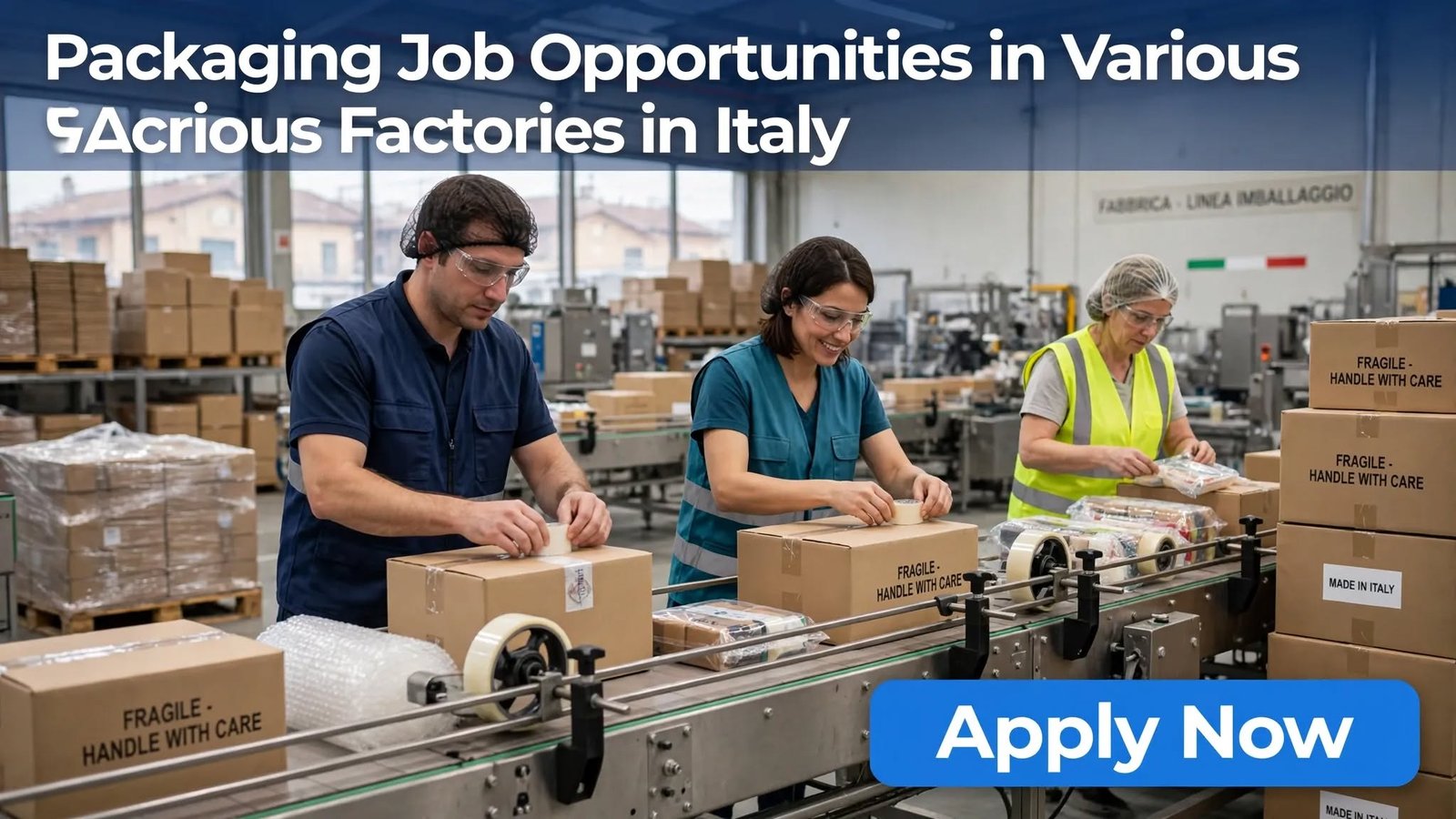
Italy is known for fashion, food and fine design. Behind every bottle of olive oil, box of pasta, pair of leather shoes or carton of medicine is a packaging line, and every packaging line needs people.
That is why packaging jobs in Italy remain one of the most accessible entry points into the Italian manufacturing sector. These roles usually don’t demand a university degree or years of experience. They reward reliability, attention to detail and a willingness to learn. For many workers from abroad, they are a first step toward stable employment in Europe.
This guide explains where packaging jobs exist, what the work involves, what you can expect to earn, how the legal entry process works, and how to avoid the scams that target job seekers. Rules change, so use this article as a starting point and confirm the details with official sources before making decisions.
Why Packaging Jobs Are in Demand in Italy
Italy has one of Europe’s largest manufacturing bases. Its factories export enormous volumes of food, beverages, pharmaceuticals, cosmetics, textiles and machinery, and every product has to be sorted, wrapped, labelled, boxed and prepared for shipping.
Several factors keep demand steady:
- A strong export economy. “Made in Italy” products must arrive undamaged and look good on the shelf.
- An ageing workforce. Many Italian factories struggle to fill production-line positions.
- Seasonal peaks. Food producers, wine bottlers and confectionery makers hire extra staff before holidays and harvest periods.
- Growth in e-commerce. Online retail has raised demand for packing and fulfilment workers near logistics hubs.
For job seekers, this means regular openings, especially in northern and central Italy, where industrial districts are concentrated.
Read Also: Jobs in Elderly Care in Italy: A Complete Guide for Job Seekers
Types of Packaging Jobs Available in Italian Factories
“Packaging worker” is a broad label. Here are the most common roles.
Manual Packer (Addetto all’imballaggio)
This is the most common entry-level role. You place products into boxes, wrap them, seal cartons and stack them on pallets. Speed and accuracy matter more than technical skill.
Packaging Line Operator (Operatore di linea)
Operators work alongside automated machines that fill, cap, seal and label products. You monitor the line, load materials, fix minor jams and report faults to technicians.
Quality Control Checker
Some workers inspect finished products for defects, check labels and expiry dates, and make sure each batch meets company standards. This role suits people with a sharp eye and a methodical approach.
Labelling and Sorting Assistant
These workers apply labels, sort products by type or destination, and prepare orders for dispatch. It is common in cosmetics, pharmaceuticals and online fulfilment.
Forklift and Pallet Handler
With the right licence, you can move packed goods to storage or loading bays. This role often pays more than basic packing.
Machine Setup Technician
With experience, motivated workers can move up to setting up and maintaining packaging machines. It is a more technical and better-paid career path.
Factories and Industries That Hire Packaging Workers
Packaging jobs appear across many sectors. Knowing the industry helps you target your search.
Food and Beverage Factories
This is the largest employer of packaging staff. Pasta makers, bakeries, dairies, canneries, olive oil producers, wineries, sauce makers and confectionery companies all need packing teams. Work in food plants usually involves strict hygiene rules, protective clothing and sometimes cold environments.
Pharmaceutical and Cosmetic Companies
These factories pay close attention to cleanliness and precision. Packaging here means blister packs, bottles, tubes and boxes that meet tight regulatory standards. Training is provided, but accuracy is essential.
Fashion, Leather and Textile Manufacturers
Italy’s fashion industry needs workers to fold, tag, wrap and box clothing, shoes and accessories. Luxury brands set high presentation standards.
Furniture and Home Goods Factories
Furniture makers need staff to protect and crate products, which can be heavy. Physical fitness helps.
Ceramics, Glass and Tile Producers
Fragile goods need careful packing. These factories are common in specific industrial districts.
E-commerce and Logistics Warehouses
Large distribution centres hire pickers and packers all year, with extra staff during sales seasons.
Where in Italy Are the Best Opportunities?
Factory jobs are not spread evenly across the country. Industrial clusters tend to offer the most openings.
- Lombardy (Milan, Brescia, Bergamo): a major hub for manufacturing, pharmaceuticals and logistics.
- Veneto (Verona, Treviso, Padua): known for food production, wine, furniture and fashion.
- Emilia-Romagna (Parma, Modena, Bologna): famous for food processing, packaging machinery and ceramics.
- Piedmont (Turin, Cuneo, Asti): food, beverages and confectionery.
- Tuscany and the Marche region: leather, footwear and textile manufacturing.
- Campania and Puglia: food processing, canning and agricultural products, with seasonal peaks.
Northern regions usually have more openings and often higher wages, but living costs, especially rent in big cities, can be higher too. Smaller industrial towns can offer a better balance.
What Does a Packaging Worker Do Day to Day?
A typical shift looks something like this:
- Preparation. Put on protective clothing, gloves or a hairnet, and check your station.
- Line setup. Load boxes, labels, film or other packaging materials.
- Packing and inspection. Pack products by hand or monitor machines while checking for defects.
- Labelling and sealing. Apply labels, batch codes and seals.
- Palletising. Stack finished boxes and prepare them for dispatch.
- Record keeping. Note quantities, report problems and keep your station clean.
Many roles involve standing for long hours, repetitive movements and, in some plants, shift work (mornings, afternoons or nights). Those are realities worth considering honestly before you apply.
Skills and Qualifications Employers Look For
You don’t need an advanced education, but certain qualities make a real difference.
Essential Qualities
- Reliability and punctuality. Production lines depend on every person being in place.
- Attention to detail. One mislabelled batch can cause costly problems.
- Physical stamina. You may stand, lift and repeat tasks for hours.
- Teamwork. Lines work as a unit.
- Willingness to follow safety and hygiene rules.
Helpful Extras
- Basic Italian. Even simple phrases help you understand instructions, safety signs and colleagues. Learning Italian is the single best investment you can make.
- Previous factory, warehouse or food-handling experience.
- A forklift licence (patentino), which opens higher-paid roles.
- Basic English, useful in export-focused companies.
Many employers provide on-the-job training, particularly for food hygiene and workplace safety, which are legally required.
Salary and Benefits: What Can You Expect?
Pay depends on the sector, region, your experience and the collective labour agreement (Contratto Collettivo Nazionale di Lavoro, or CCNL) that governs the company. As a rough, indicative guide, entry-level packaging and production workers often earn somewhere between €1,400 and €2,000 gross per month. Night shifts, overtime and specialist skills can raise that figure. Treat these as approximations, because actual offers vary, and always check the exact figure in your contract.
Common Benefits Under Italian Employment Law
- A written employment contract that sets out your role, hours and pay.
- Paid annual leave and public holidays.
- Social security and health coverage through the national system.
- Severance pay (TFR), accumulated during your employment.
- Extra monthly salaries. Many contracts include a 13th-month payment, and some include a 14th.
- Overtime and night-shift supplements, as defined by the relevant agreement.
Ask for the contract in writing and make sure you understand it before signing. If you cannot read Italian, ask a trusted person or a legal advisor to review it.
Visa and Work Permit Basics for Non-EU Citizens
If you are a citizen of an EU country, you can generally look for work in Italy freely. If you are from outside the EU, the process is more structured, and this is where most job seekers need to be careful.
The Decreto Flussi System
Italy controls legal worker entry through a three-year government decree known as the Decreto Flussi, which sets annual quotas. The worker cannot submit the application independently: they must be selected by an Italian employer willing to hire them. In other words, your future employer starts the process, not you. esteri
According to the programme for 2026–2028, quotas for non-seasonal employed work amount to 76,200 units for each of the three years. Packaging and factory roles generally fall under non-seasonal subordinate work, although food-processing companies sometimes use seasonal channels as well. esteri
For the upcoming round, Italy published operational guidance for the 2027 Flow Decree on 1 October 2026, and employers can pre-fill applications from 23 October to 7 December 2026. The same source lists 16 February 2027 as the date for non-seasonal employment applications using form B2020. Pre-filling alone does not submit an application, so timing and paperwork matter. Dates and rules can be updated, so verify them with the Italian Ministry of the Interior or the nearest Italian embassy or consulate. arlettipartnersarlettipartners
Typical Steps in the Process
- An Italian employer decides to hire a worker from abroad and applies for authorisation (nulla osta) during the official application window.
- The authorities review the application.
- If approved, the authorisation is sent to the Italian consulate in your country.
- You apply for the work visa at the consulate with your passport and supporting documents.
- After arriving in Italy, you complete formalities such as signing the residence contract and applying for your residence permit.
Quotas are limited, the process takes months, and not every nationality has the same access, since some quota portions are reserved for countries that have migration cooperation agreements with Italy. Ask for guidance from official sources rather than relying on rumours.
How to Find Packaging Jobs in Italy
1. Search Reputable Job Platforms
Italian and international job portals list factory and warehouse openings. Search in Italian using terms like addetto imballaggio, operaio di produzione, addetto confezionamento and operatore di linea.
2. Contact Employment Agencies
Italy has many licensed temp agencies (agenzie per il lavoro) that place workers in factories. Legitimate agencies are registered and never charge you a fee for finding a job.
3. Go Directly to Company Websites
Food, beverage and manufacturing companies often post openings in the “Careers” or “Lavora con noi” section of their websites.
4. Use Public Employment Services
Italy’s public employment centres (Centri per l’impiego) help residents and eligible workers find jobs.
5. Network
If you already know people in Italy, ask about openings. Many factory jobs are filled by word of mouth.
6. Prepare a Strong Application
- Write a one-page CV with clear dates and relevant experience.
- Add a short, polite cover message, ideally in simple Italian.
- Mention any factory, warehouse, food-handling or machinery experience.
- Keep copies of certificates, licences and references ready.
Avoiding Job Scams: Protect Yourself
Unfortunately, overseas job seekers are common targets of fraud. Learn the warning signs.
- Anyone asking you to pay for a “guaranteed” job, visa or work permit should be treated with extreme caution. A legitimate Italian employer does not sell jobs.
- Offers without an interview or any checking of your skills are suspicious.
- Promises of very high pay for unskilled work are a red flag.
- Pressure to act fast or send money by untraceable methods is a classic scam tactic.
- Fake documents or “visa agents” with no verifiable registration can leave you without money and without a visa.
Verify any company by checking its official website, its registration and its contact details. If in doubt, contact the nearest Italian embassy or consulate. Staying cautious now can save you from losing your savings.
Life as a Factory Worker in Italy
Understanding daily life helps you decide whether the move is right for you.
Working Conditions
Italian labour law sets rules on working hours, rest breaks and safety. Workplaces must provide safety training and protective equipment. Unions are active in many factories, and your CCNL spells out your rights.
Cost of Living
Rent is usually the biggest expense. Smaller industrial towns are generally cheaper than Milan or Bologna. Some employers or agencies can help with accommodation advice, and sharing a flat is common among new arrivals.
Language and Integration
Learning Italian makes everything easier, from understanding your supervisor to making friends and handling paperwork. Free or low-cost language courses are often available through local associations and adult education centres.
Career Growth
Packaging is a strong starting point. Many workers progress by:
- Gaining a forklift licence
- Learning to operate and set up machines
- Moving into quality control or team leader roles
- Taking technical courses in mechanics, automation or logistics
Practical Tips to Improve Your Chances
- Start learning Italian early, even basic phrases.
- Gain relevant certifications, such as food safety or forklift operation, where possible.
- Be flexible about location and shifts.
- Keep your documents organised: passport, certificates, references and a clean CV.
- Apply to multiple employers and stay patient, because international hiring takes time.
- Use only official channels for visa and permit information.
Conclusion
Packaging jobs in Italian factories offer a realistic, accessible path into the country’s manufacturing sector. They exist across food, beverages, pharmaceuticals, fashion, furniture and e-commerce, with the strongest demand in northern and central industrial regions. The work is physical and repetitive, but it offers a regular contract, legal protections and room to grow.
If you are applying from outside the EU, remember that the process runs through the Decreto Flussi system. Your employer must start the application, quotas are limited and timing matters. Stay alert to scams, rely on official sources and invest in learning Italian, because that is what turns an entry-level job into a long-term career.
Frequently Asked Questions (FAQ)
1. Do I need a degree to get a packaging job in Italy?
No. Most packaging roles are entry-level and don’t require a degree. Employers care more about reliability, physical fitness and willingness to learn.
2. Do I need to speak Italian?
Basic Italian is very helpful and sometimes required for safety reasons, though some employers hire workers with limited Italian for simple tasks. Learning the language greatly improves your options.
3. Can I apply for a packaging job in Italy from abroad?
Yes, but non-EU citizens cannot simply apply for the work permit themselves. An Italian employer must submit the application under the Decreto Flussi quota system, and you then complete the visa process at the Italian consulate.
4. How much does a packaging worker earn in Italy?
Entry-level pay is often roughly between €1,400 and €2,000 gross per month, depending on the sector, region, shifts and contract. Check the exact figure and the applicable CCNL in your contract.
5. Are packaging jobs in Italy seasonal or permanent?
Both exist. Food and beverage companies often hire seasonally, while many factories and logistics centres offer fixed-term contracts that can become permanent.
6. Which regions have the most packaging jobs?
Lombardy, Veneto, Emilia-Romagna and Piedmont have large industrial and food-processing sectors, so they generally offer the most openings.
7. Should I pay a recruiter or agent to get a job in Italy?
Be very careful. Legitimate employers and licensed agencies do not charge job seekers fees for placement. Requests for upfront payment are a common sign of fraud.
8. Can I grow my career from a packaging job?
Yes. With experience, training and a forklift licence or technical skills, you can move into machine operation, quality control, logistics or supervisory roles.