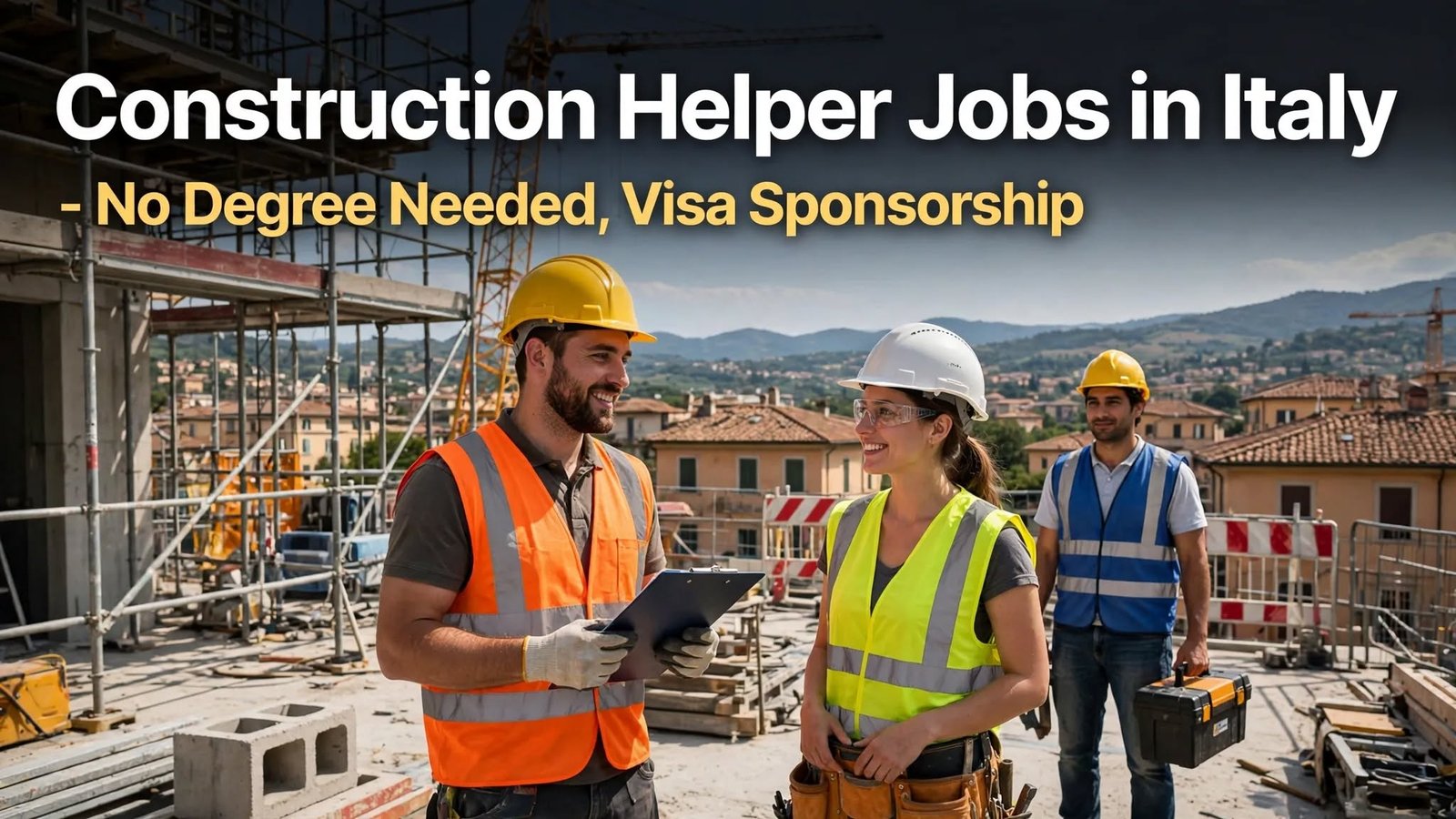
Italy is known for its art, food, and history. Behind that image is a country that is constantly building, repairing, and restoring. Roads need resurfacing. Apartment blocks need energy upgrades. Historic buildings need careful renovation. All of this work needs people, and construction helpers are among the most in-demand workers on any Italian building site.
If you are looking for an entry-level way into the European job market, this role deserves a close look. It does not always require a university degree or years of experience. It does require a strong work ethic, physical fitness, and a willingness to learn. This guide covers what the job involves, what you can earn, how the visa system works, and how to apply without falling for scams.
Introduction: Why Construction Helpers Are Needed in Italy
Italy’s construction sector has had a strong run in recent years. Government incentives for home renovation and energy efficiency have kept building firms busy. Large public projects have added more demand. At the same time, many experienced Italian tradespeople are approaching retirement, and fewer young Italians are choosing manual trades.
The result is a gap between the work available and the people available to do it. Employers, especially small and medium-sized firms, increasingly look abroad for reliable workers. A construction helper (manovale or operaio generico edile in Italian) is often the first role they try to fill.
What Does a Construction Helper Do in Italy?
A construction helper supports skilled workers such as bricklayers, carpenters, electricians, plumbers, and plasterers. You are the person who keeps the site running smoothly.
Read Also: Labor Job Opportunities in Italy: A Complete Guide for Foreign Workers
Typical Daily Duties
- Loading and unloading building materials such as bricks, cement bags, tiles, and timber
- Mixing mortar and concrete according to the foreman’s instructions
- Digging trenches and preparing foundations
- Assembling and dismantling scaffolding under supervision
- Cleaning the site and removing debris
- Carrying tools and assisting skilled workers
- Operating basic equipment such as wheelbarrows, mixers, and, with training, small machinery
- Following safety rules and wearing protective equipment at all times
A Stepping Stone, Not a Dead End
Many people start as helpers and grow into skilled roles. Working next to a bricklayer or a carpenter lets you learn the trade on the job. After a year or two, you may be trusted with more technical tasks, and your pay can rise with your skills.
Types of Construction Work Where Helpers Are Hired
Helpers are needed across many parts of the sector. Knowing the main categories can help you target your search.
1. Residential Building and Renovation
Apartment buildings, villas, and home renovations employ many helpers. Renovation projects, especially those focused on insulation, facades, and roofs, are a large source of work.
2. Road and Infrastructure Construction
Road building, bridge repair, drainage, and utility installation all need general labourers. These jobs may involve travel between sites.
3. Restoration of Historic Buildings
Italy has an enormous number of old buildings. Restoration companies hire helpers to assist with scaffolding, material handling, and site preparation.
4. Industrial and Commercial Construction
Warehouses, factories, shopping centres, and logistics hubs are built across northern Italy in particular. These sites usually use larger crews and more formal processes.
5. Demolition and Site Clearing
Demolition crews need helpers to clear rubble and sort materials. The work is physically demanding and requires strict safety discipline.
How Much Do Construction Helpers Earn in Italy?
Pay depends on the region, the employer, your experience, and the contract type. Construction in Italy is covered by national collective labour agreements (contratti collettivi nazionali, or CCNL), which set minimum wages and conditions for each job level.
General Salary Expectations
- Entry-level helpers typically earn in the range of roughly €1,200 to €1,600 net per month, depending on hours and location
- Experienced helpers or those with specific certifications may earn more
- Overtime is usually paid at a higher rate, and some sites offer bonuses for difficult conditions
These figures are rough estimates. Exact numbers vary, so always check the contract and compare it to the applicable CCNL minimums before accepting an offer.
Other Benefits to Look For
- Paid holidays and a thirteenth-month payment (tredicesima) in many contracts
- Social security and pension contributions
- Accident and health insurance coverage
- Severance pay (TFR), which accrues over time
- In some cases, employer-arranged accommodation or meal allowances
Cost of Living Matters
Salaries in northern cities such as Milan are higher but so are rents. In smaller towns and in the south, wages may be lower but living costs are often more manageable. Think about your take-home pay after rent, food, and transport, not just the headline salary.
Best Regions in Italy for Construction Helper Jobs
Northern Italy (Lombardy, Veneto, Emilia-Romagna, Piedmont)
The north is the industrial heart of the country. It has the highest concentration of building firms, large projects, and generally better wages. Competition for jobs can be stronger, but so is demand.
Central Italy (Lazio, Tuscany, Marche)
Rome and surrounding areas have ongoing renovation and public works. Tuscany offers steady restoration and residential work.
Southern Italy and the Islands
The south has infrastructure projects and growing renovation activity. Wages may be lower, but you may find less competition in some areas.
Tip
Choose a region based on your priorities: higher pay, lower living costs, or a particular community you want to be near.
Visa and Work Permit Options for Foreign Construction Workers
This is the section many applicants worry about most, and rightly so. Italy does not allow foreigners from outside the European Union to simply arrive and look for work. You need the right authorization before you travel for work.
EU and EEA Citizens
If you are a citizen of an EU or EEA country, you can live and work in Italy without a work visa. You will still need to register for a tax code (codice fiscale) and complete local residence formalities.
Non-EU Citizens: The Decreto Flussi System
For most non-EU workers, the main route is the Decreto Flussi, an Italian government decree that sets annual quotas for foreign workers in different sectors. Construction is one of the sectors that has been included in these quotas.
Here is how the process generally works:
- The employer applies. An Italian employer submits a request for a foreign worker during the application window set by the government.
- Authorization is granted. If approved within the quota, the employer receives a work authorization (nulla osta).
- You apply for a visa. With the nulla osta, you apply for a work visa at the Italian embassy or consulate in your home country.
- You travel and sign a residence contract. After arrival, you complete the paperwork and apply for a residence permit (permesso di soggiorno).
Important Points
- The employer must start the process. A worker cannot apply for the quota on their own.
- Quotas are limited and application windows are short, so timing matters.
- Rules, quotas, and procedures change from year to year. Always check the official Italian government and embassy websites for the current requirements before you act.
Other Possible Routes
- Family reunification if a relative already lives legally in Italy
- Seasonal work permits, which sometimes cover construction-adjacent work
- Study-to-work conversions or other permits that allow employment
Because immigration rules are complex and change often, consider speaking to a qualified immigration lawyer or an authorized agency if you are unsure.
Documents You May Need
Requirements vary by case, but you should expect to prepare some or all of the following:
- Valid passport with enough remaining validity
- Work authorization (nulla osta) issued for your employer’s request
- Work visa application and supporting forms
- Proof of accommodation in Italy
- Police clearance certificate from your home country
- Medical documents or health insurance, if requested
- Educational or training certificates, if you have any
- Passport-sized photographs
- Translated and legalized documents, where required
Start collecting documents early. Delays in getting certificates translated or legalized are one of the most common reasons applications stall.
Skills and Qualities Employers Look For
You do not always need formal qualifications, but employers do notice certain traits.
Practical Qualities
- Physical fitness and stamina for long days of manual work
- Reliability and punctuality, as site schedules are tight
- Ability to follow instructions exactly, especially around safety
- Teamwork and respect for supervisors and co-workers
- Willingness to learn new tasks and techniques
Helpful Extras
- Basic Italian: even simple phrases for tools, materials, and safety instructions help you at work and earn trust quickly
- Previous construction experience, even informal, is a plus
- A driving licence can sometimes be useful
- Safety training certificates can set you apart
Safety Training in Italy
Italian law places strong emphasis on workplace safety. Employers must provide safety training, and workers are expected to follow it. Basic safety training for construction is typically arranged through the employer. Take it seriously. Construction is a high-risk industry, and good safety habits protect you and your colleagues.
How to Find Construction Helper Jobs in Italy
1. Online Job Portals
Look at established Italian job platforms and general European job sites. Search using terms like “manovale edile,” “operaio edile,” and “aiutante muratore.” Searching in Italian often surfaces more listings than searching in English.
2. Company Websites and Construction Firms
Many building companies post vacancies directly on their sites. Larger firms may have a careers page.
3. Temporary Employment Agencies
Italy has licensed staffing agencies (agenzie per il lavoro) that place workers in construction roles. Legitimate agencies do not charge workers a fee for placement.
4. Professional Networks
LinkedIn and similar networks help you connect with recruiters and company representatives. A clear, honest profile that lists your skills and experience can help.
5. Official Channels
Check official government resources and Italian embassy websites for information about legal recruitment and quota-based hiring.
6. Word of Mouth
In practice, many helpers find jobs through contacts: friends, relatives, or former colleagues who already work in Italy. A personal recommendation carries weight, though you should still verify any employer yourself.
How to Apply: A Step-by-Step Approach
- Prepare a simple CV. Keep it to one page. Include your contact details, work history, relevant skills, languages, and any certificates.
- Write a short cover message. Explain who you are, what you can do, and why you want the role. Keep it polite and direct.
- Apply to genuine vacancies. Target employers and agencies that are verifiable and legitimate.
- Prepare for interviews. These may happen by phone or video. Be ready to discuss your experience, availability, and willingness to relocate.
- Review the contract carefully. Check the salary, hours, duration, accommodation terms, and which collective agreement applies. Ask for a translated copy if you need one.
- Complete the visa process. Once the employer has secured authorization, follow the embassy instructions step by step.
Avoiding Job Scams: Protect Yourself
Unfortunately, the dream of working in Europe attracts fraudsters. Construction helper roles are a common target because demand is high and applicants are often eager. Stay alert.
Warning Signs
- Anyone asking you to pay a large fee for a guaranteed job or visa
- Offers that seem too good to be true, such as very high pay for no experience
- No written contract, or a contract you are pressured to sign immediately
- Unverifiable companies with no address, website, or registration details
- Requests to send money through informal channels
- Promises of a visa without any employer authorization
Protect Yourself
- Verify the company independently
- Never hand over original documents to unverified people
- Keep copies of every document and message
- Use only official channels for visa applications
- If something feels wrong, stop and seek advice from an embassy or a trusted professional
Legitimate employers cover the costs of the official hiring process. Treat requests for big payments as a serious red flag.
Life and Work in Italy: What to Expect
Working Hours and Conditions
Standard working weeks are typically around 40 hours, with set break times. Summers can be very hot, and some regions adjust site hours during extreme heat to protect workers.
Accommodation
Some employers help with housing. If not, you will need to find a room or shared apartment. Costs vary widely by city.
Language
Italian is the working language. You can get by with basic phrases at first, but learning more quickly improves your safety, your relationships, and your chances of promotion. Free and low-cost language classes are available in many towns.
Healthcare and Rights
Workers with legal contracts and permits generally have access to the Italian healthcare system and are covered by labour protections. Trade unions and workers’ associations can also provide support if problems arise.
Culture
Italians value punctuality on site, respect between colleagues, and, famously, a proper lunch break. Showing willingness to join in and respect local customs helps you settle in.
Career Growth: From Helper to Skilled Worker
The helper role can be the start of a longer career in the trades.
A Possible Path
- Construction helper (manovale): You learn the basics.
- Specialized worker (operaio qualificato): You take on trade-specific tasks such as masonry, drywall, or formwork.
- Skilled worker (operaio specializzato): You work independently on technical jobs.
- Team leader or foreman (caposquadra): You supervise others.
- Business owner or contractor: Some experienced workers eventually start their own small firms.
How to Move Up
- Ask to learn new tasks
- Attend vocational and safety courses
- Improve your Italian
- Earn certifications for machinery or specialized techniques
- Build a reputation for quality and reliability
Pros and Cons of Construction Helper Work in Italy
Advantages
- Low entry barrier compared with many skilled professions
- Steady demand in many regions
- On-the-job training and a path to skilled roles
- Access to European labour protections under a legal contract
- Chance to build a long-term life in Italy
Challenges
- Physically demanding work
- Seasonal variation in some regions
- Language barrier at the start
- Bureaucracy around visas and permits
- Competition for quota-based places
Going in with realistic expectations helps you make better decisions and handle difficulties when they arise.
Conclusion
Construction helper jobs in Italy offer a real opportunity for people who are willing to work hard and follow the proper legal process. The sector needs workers, wages under collective agreements provide a fair baseline, and the role can lead to skilled positions over time.
The most important advice is simple: go through legal channels, verify every employer, and never pay for a guaranteed job. Prepare your documents early, learn some Italian, and stay informed about current visa rules from official sources. With patience and preparation, you can build a stable career on Italian building sites.
Frequently Asked Questions (FAQ)
1. Can I get a construction helper job in Italy without experience?
Yes, many entry-level helper roles do not require previous experience. Employers value reliability, fitness, and willingness to learn. Prior experience or basic Italian can improve your chances.
2. Do I need to speak Italian?
It is not always required at the start, but basic Italian is very helpful for safety and communication. Learning the language will also help you progress in your career.
3. How much does a construction helper earn in Italy?
Entry-level helpers often earn roughly €1,200 to €1,600 net per month, depending on region, hours, and contract. Check the applicable collective agreement for exact minimums.
4. Do employers in Italy sponsor visas for construction workers?
Some do, mainly through the Decreto Flussi quota system, where the employer starts the application. Quotas are limited, and rules change each year, so confirm current details on official websites.
5. Can I apply for a work visa on my own?
For most non-EU workers, the employer must first obtain work authorization. You then apply for the visa at the Italian embassy or consulate in your country.
6. Is it legal to pay an agent for a job in Italy?
Legitimate recruitment should not require large payments from workers for a guaranteed job or visa. Be cautious and verify any agency before sharing money or documents.
7. Which region of Italy has the most construction jobs?
The north, including Lombardy, Veneto, and Emilia-Romagna, has the largest concentration of construction firms. Central and southern regions also offer opportunities, especially in renovation and infrastructure.
8. Can a construction helper become a skilled worker?
Yes. With experience, training, and better language skills, many helpers move into skilled trades or supervisory roles.
9. How long does the visa process take?
It varies. The employer’s authorization stage, document preparation, and embassy processing all add time. Start early and expect it to take several months.
10. Is construction work in Italy safe?
Italy has strict safety regulations, and employers must provide training and equipment. Construction remains a high-risk industry, so always follow safety rules and speak up if conditions seem unsafe.
Disclaimer: Salary figures, visa procedures, and quotas change regularly. Always confirm current information with official Italian authorities, embassies, or a qualified immigration professional before making decisions.
One thought on “Construction Helper Job Opportunities in Italy: A Complete Guide for Foreign Workers”