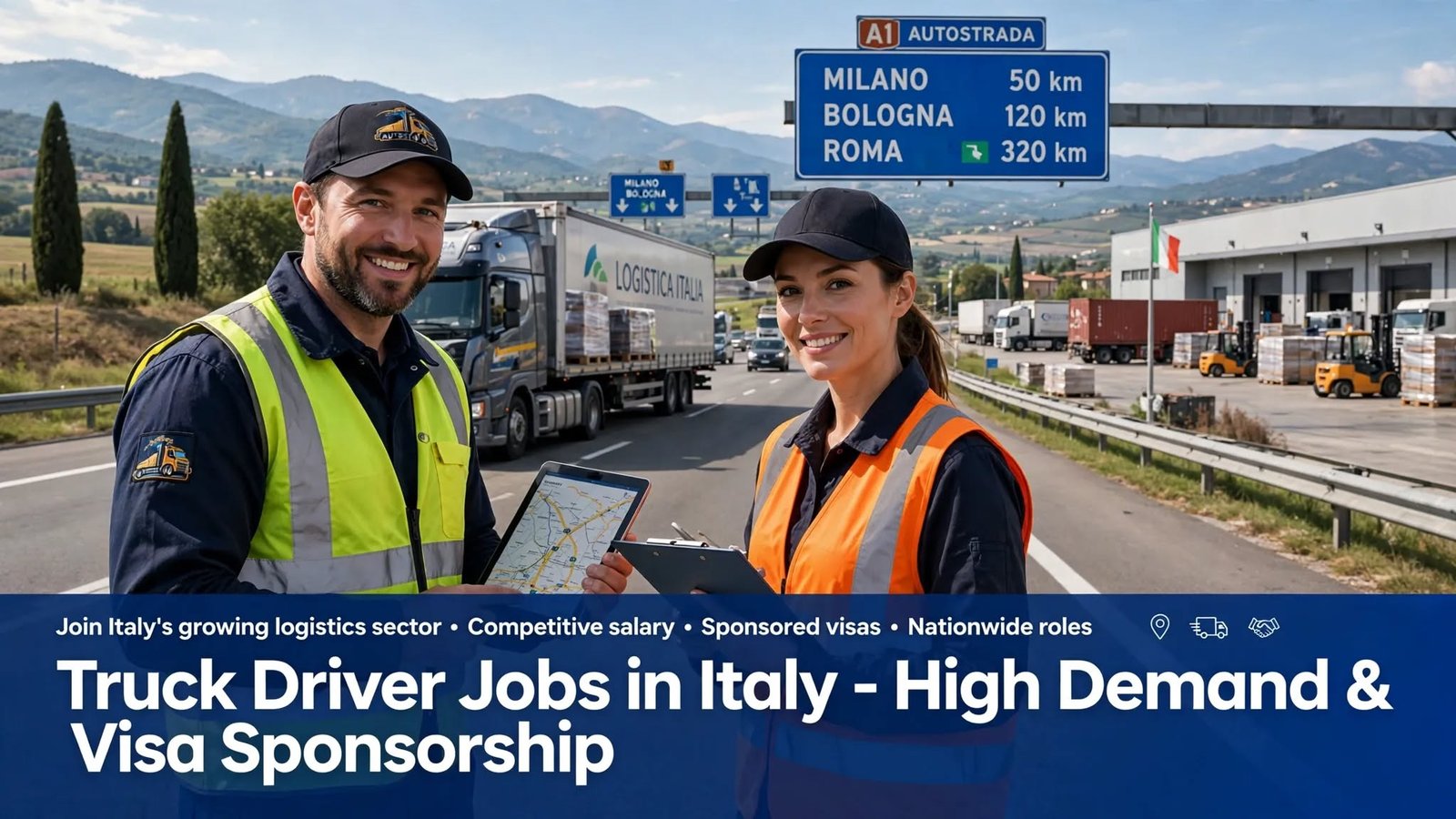
Every product on an Italian shelf, from olive oil in Puglia to car parts in Piedmont, spent part of its journey in the back of a truck. Italy’s economy depends on road transport more than most European countries. A large share of the country’s freight moves by road, and the people behind the wheel are in short supply.
That shortage is why truck driver jobs in Italy attract so much interest from experienced drivers abroad. Employers struggle to fill vacancies, the work is steady all year, and Italy is a good base for international routes across Europe.
But the process is more demanding than many online job posts suggest. Licenses must be recognized, qualification cards must be held, and visas must follow proper legal channels. This guide covers what the job involves, what you can earn, which documents you need, and how to avoid the scams that target hopeful drivers.
Why Italy Needs Truck Drivers
Several forces have combined to create strong demand for drivers.
- An ageing workforce. Many Italian drivers are close to retirement, and fewer young Italians enter the profession.
- A strong manufacturing and export base. Northern Italy is one of Europe’s industrial heartlands, and its goods need constant movement.
- Growth in e-commerce. Online shopping has multiplied parcel and pallet deliveries, even in smaller towns.
- Italy’s geography. Mountains, long coastlines, and a narrow peninsula mean rail and sea cannot replace trucks for most deliveries.
- Cross-border trade. Italy connects to Austria, Switzerland, France, and Slovenia, with heavy traffic through the Alpine passes.
Read Also: Fruit Farm Jobs in Italy: A Complete Guide to Seasonal Harvest Work, Visas and Pay
Industry associations have repeatedly warned of a shortfall of drivers running into the tens of thousands. Exact figures change from year to year, so check recent reports before quoting a number, but the direction is clear: companies want qualified drivers.
Types of Truck Driver Jobs in Italy
“Truck driver” covers very different lifestyles. Choosing the right type matters as much as finding a vacancy.
Local and Regional Delivery Driver
You start and finish your day at the same depot, usually delivering within a city or region. Hours are more predictable and you sleep at home most nights. This is common for supermarket distribution, building supplies, and beverage delivery.
National Long-Haul Driver
You travel between Italian regions, for example from Lombardy to Sicily. Trips can last several days, and you may sleep in your cabin.
International Driver (Europe)
International work pays more, often through daily allowances, but takes you away from home for weeks at a time. Routes commonly link Italy with Germany, France, Spain, Austria, and Eastern Europe.
Specialized Driver
Some of the best-paid roles require extra certification:
- ADR drivers who carry dangerous goods such as fuel and chemicals
- Refrigerated (reefer) transport for fresh food and pharmaceuticals
- Tanker drivers for liquids and bulk materials
- Car transporter and heavy-haul drivers for oversized or special loads
Owner-Operator or Subcontractor
Some drivers work through their own vehicle and contract with larger logistics firms. This brings independence but also costs, paperwork, and financial risk, so it suits drivers who already know the Italian market.
Requirements to Work as a Truck Driver in Italy
Italy follows EU rules, and the requirements are strict. These are the main items.
1. The Right Driving License
- Category C for rigid trucks over 3.5 tonnes
- Category CE for articulated lorries (a tractor unit with a trailer), which is the most in demand
If your license was issued in an EU or EEA country, it is valid in Italy. If it was issued in a non-EU country, the situation is harder. Italy only exchanges licenses from countries with an agreement, and heavy-vehicle categories are often excluded. Many foreign drivers must take Italian theory and practical tests. Check the current rules with the Italian authorities or an accredited driving school before planning your move.
2. CQC (Carta di Qualificazione del Conducente)
The CQC is the Driver Qualification Card required across the EU for professional drivers. It proves you completed initial training and shows that you keep up with periodic training, usually every five years. Without a valid CQC, you cannot legally work as a professional driver in Italy.
3. Digital Tachograph Driver Card
Italian trucks use digital tachographs to record driving and rest times. You need a personal driver card, which is issued locally.
4. Age Requirements
Age rules depend on the license category and training route, and they can be lower for drivers who complete accelerated training. Check the current minimum age for your category with the authorities.
5. Medical Fitness
Professional drivers must pass a medical examination that covers vision, hearing, and general health. It is renewed periodically.
6. Language Skills
You do not need perfect Italian, but you need enough to read road signs, understand safety instructions, complete delivery paperwork, and talk to dispatchers. Basic Italian (around A2 level) improves your chances of being hired and makes daily life much easier. English is common on international routes, but it is not a substitute for Italian on domestic jobs.
7. Optional but Valuable Extras
- ADR certificate for dangerous goods
- Experience with forklift or crane-mounted trucks
- Clean driving history and a clear record
- Familiarity with EU driving-time rules and CMR documents
How Much Do Truck Drivers Earn in Italy?
Pay depends on the company, region, route type, and your experience. Most Italian drivers are covered by the national collective agreement for logistics, freight transport, and shipping, which sets minimum wage levels and conditions.
As a general guide, many full-time drivers earn a gross monthly salary in the range of roughly €1,600 to €2,400, with higher totals possible once allowances are included. Treat this as a rough range, not a promise. Actual offers vary widely.
What increases your total pay:
- Trasferta (travel allowance) for nights away from home
- Overtime and night work
- ADR and other specialized certifications
- International routes
- Performance or safety bonuses
Also check these before accepting an offer:
- Whether the contract is permanent (tempo indeterminato) or fixed-term
- Whether allowances are part of the official payslip
- Who pays for fuel cards, tolls, and fines
- How rest time is handled when you are away
A good employer puts all of this in writing.
Work Visa Options for Foreign Truck Drivers
If you are a citizen of a country outside the EU, you generally cannot just fly to Italy and start working. A legal route is required.
The Decreto Flussi System
Italy allocates yearly quotas for non-EU workers through the Decreto Flussi. An employer in Italy applies for authorization to hire a foreign worker, and if approved, the worker applies for a work visa at the Italian consulate in their home country. Transport and driving roles have appeared in these quotas, but the sectors, numbers, and dates change every year, so always check the latest official announcement.
How the Process Generally Works
- An Italian employer submits a request during the official application window.
- The authorities review it and issue a nulla osta (work authorization) if approved.
- You apply for the visa at the Italian embassy or consulate.
- After arriving, you apply for a residence permit (permesso di soggiorno) within the legal deadline.
Important Reality Check
A work authorization does not replace the need for a valid license and qualifications. Some applicants obtain a visa and then discover their license is not recognized. Sort out the license question early.
Where to Find Truck Driver Jobs in Italy
Online Job Platforms
Search for terms such as autista camion, autista patente C/E, autista CE, and camionista. Large Italian and European job boards list thousands of driver vacancies, and international sites can help with cross-border roles.
Recruitment and Staffing Agencies
Italian staffing agencies (agenzie per il lavoro) hire many drivers on fixed-term contracts. Some also recruit from abroad, but only agencies authorized by Italian authorities should be trusted.
Direct Applications to Logistics Companies
Many carriers accept direct applications on their websites. Focus on regions with heavy freight activity, such as Lombardy, Emilia-Romagna, Veneto, Piedmont, and Lazio.
Networking and Industry Groups
Truckers’ forums, transport associations, and professional social media groups are good for honest feedback about specific employers. Ask real drivers what working for a company is like before you commit.
Step-by-Step: How to Apply for Truck Driver Jobs in Italy
- Check your license status. Find out whether your category C or CE license is valid or convertible in Italy.
- Get your qualifications in order. Confirm your CQC and tachograph card requirements.
- Prepare your CV in Italian format. Keep it to one or two pages, list your license categories, years of experience, types of freight, and countries you have driven in.
- Learn basic Italian. Even a few months of study sets you apart.
- Research employers. Look for established companies with a real address, VAT number (partita IVA), and online reputation.
- Apply and interview. Expect questions about your experience, safety record, and willingness to travel. Some employers ask for a practical driving test.
- Get a written contract. Read it carefully, ideally with a translation.
- Follow the visa process. Use official channels only.
Daily Life and Working Conditions
Driving Time Rules
EU regulations strictly control working time to prevent fatigue. In general:
- Daily driving is limited to about 9 hours, extendable to 10 hours twice a week.
- A 45-minute break is required after 4.5 hours of driving.
- Weekly and fortnightly driving totals are capped.
- Regular daily and weekly rest periods are mandatory.
Tachographs record all of this, and violations bring heavy fines for both driver and company.
Roads and Challenges
Italy’s road network is good, but drivers face real difficulties:
- Toll roads (autostrade) with significant costs
- Narrow historic streets in towns and villages
- Heavy traffic around Milan, Rome, and Naples
- Alpine passes that can close in winter
- Weekend and holiday restrictions on heavy vehicles on certain roads
Rest Stops and Lifestyle
Italian motorway service areas (aree di servizio) are generally decent, with food, showers, and parking. Many drivers enjoy the food culture along the way, since even a roadside stop can serve a real espresso and a hot meal.
Safety and Health
Long hours, irregular sleep, and time away from family are the toughest parts of the job. Smart drivers protect their health by planning meals, exercising when they can, and respecting rest rules.
Career Growth and Opportunities
A driver’s career does not have to stay in one place. Possible next steps include:
- Moving into specialized transport like ADR or refrigerated freight for higher pay
- Becoming a trainer or instructor at a driving school
- Working as a dispatcher or transport planner
- Becoming a fleet supervisor or logistics coordinator
- Starting your own transport business after learning the market
Italy’s logistics sector is growing, so experienced drivers with Italian language skills often find doors opening.
Pros and Cons of Truck Driving in Italy
Pros
- High demand and strong job security
- Opportunities for overtime and allowances
- Legal route to work in Europe for those who qualify
- A chance to see Italy and the rest of Europe
- Clear career paths into specialized and supervisory roles
Cons
- Long periods away from home
- Strict regulations and heavy fines
- License conversion can be slow and costly for non-EU drivers
- Physical strain and irregular schedules
- Competition from drivers across Eastern Europe
Avoiding Job Scams
Because driver demand is well known, scammers target hopeful applicants. Watch for these red flags:
- Requests for upfront fees for “visa processing,” “job guarantee,” or “contract release”
- Promises of guaranteed jobs with no interview
- Unrealistic salaries far above market rates
- No verifiable company details, such as address, VAT number, or website
- Communication only through messaging apps with no official email
- Pressure to pay quickly or to send money to individuals
Legitimate employers do not charge workers to hire them. Verify any company through official Italian business registries, and confirm visa information directly with the Italian embassy or consulate in your country.
Tips to Improve Your Chances
- Aim for CE category experience, since it is the most requested.
- Get your ADR certificate if you can, because it can lift your pay.
- Learn basic Italian before applying.
- Keep your driving record clean and your documents organized.
- Build a short professional profile with references from previous employers.
- Be flexible about region and route type when you start.
- Be patient. The paperwork takes months, not days.
Conclusion
Truck driver jobs in Italy offer real opportunity for qualified drivers. Demand is strong, pay can be fair, and the road to a long career is open. But success depends on preparation: a valid license, a CQC, some Italian, and a legal path to employment. Take time to research employers, read every contract, and avoid anyone who asks for money before offering a real job.
If you do it the right way, the road to Italy’s logistics industry can lead to a stable and rewarding career.
Frequently Asked Questions (FAQ)
1. Can foreigners work as truck drivers in Italy?
Yes, but non-EU citizens usually need a work authorization and visa, often through the Decreto Flussi quota system, plus a recognized license and the required qualifications.
2. Is a foreign truck license valid in Italy?
EU and EEA licenses are valid. Licenses from other countries may not be exchangeable for heavy categories, so you may need to take Italian tests. Check with the authorities.
3. What is the CQC card?
The CQC is the professional qualification card for truck and bus drivers in the EU. It is mandatory for working as a professional driver in Italy.
4. How much does a truck driver earn in Italy?
Many drivers earn roughly €1,600 to €2,400 gross per month, with higher totals possible through allowances, overtime, and specialization. Actual figures vary by employer.
5. Do I need to speak Italian?
Basic Italian is strongly recommended. Some international routes use English, but Italian is useful for paperwork, safety, and daily life.
6. Which license category is most in demand?
Category CE (articulated lorries) is generally the most sought after.
7. Are there truck driver jobs with visa sponsorship?
Some employers can sponsor foreign workers through official quota procedures, but opportunities vary by year. Never pay anyone for a “guaranteed” sponsorship.
8. How can I avoid job scams?
Avoid upfront fees, verify the company’s registration and address, insist on a written contract, and confirm visa procedures with the Italian embassy.
9. Which regions have the most trucking jobs?
Northern regions like Lombardy, Veneto, Emilia-Romagna, and Piedmont have the largest freight activity, along with Lazio and Campania in the center and south.
10. Can I bring my family?
Family reunification may be possible after you meet income, housing, and residence permit conditions. Check the current requirements with the Italian authorities.
One thought on “Truck Driver Jobs in Italy: Salary, Requirements and How to Get Hired”